
We'll discuss your goals, current challenges, and how our process can help to drive real business growth.
SEO
9 Signals Google Uses To Rank Your Website on Search and AI Overviews
Pritesh Jagtap
March 14, 2026
5 min
TABLE OF CONTENTS
For a long time, SEO felt like a simple trade. Put the right keywords on a page, earn some backlinks, and Google rewards you with rankings and traffic. That model still holds some truth, but it is no longer the whole picture.
Google is now doing two jobs simultaneously. It ranks results in the traditional list view, but it also generates AI Overviews that summarize answers and cite sources. seoClarity data from September 2025 shows AI Overviews appearing on 30% of U.S. desktop keywords. When an AI Overview shows up, click behavior changes dramatically. Research covered by Search Engine Land found organic CTR for those queries dropping from 1.76% to 0.61%.
So the goal has shifted. It is not only about ranking, it is about ranking high enough to be eligible, then structuring content so Google can safely extract and cite it.
This article walks through the signals that actually drive both outcomes, and what you can do about each one.
The Three Layer Model
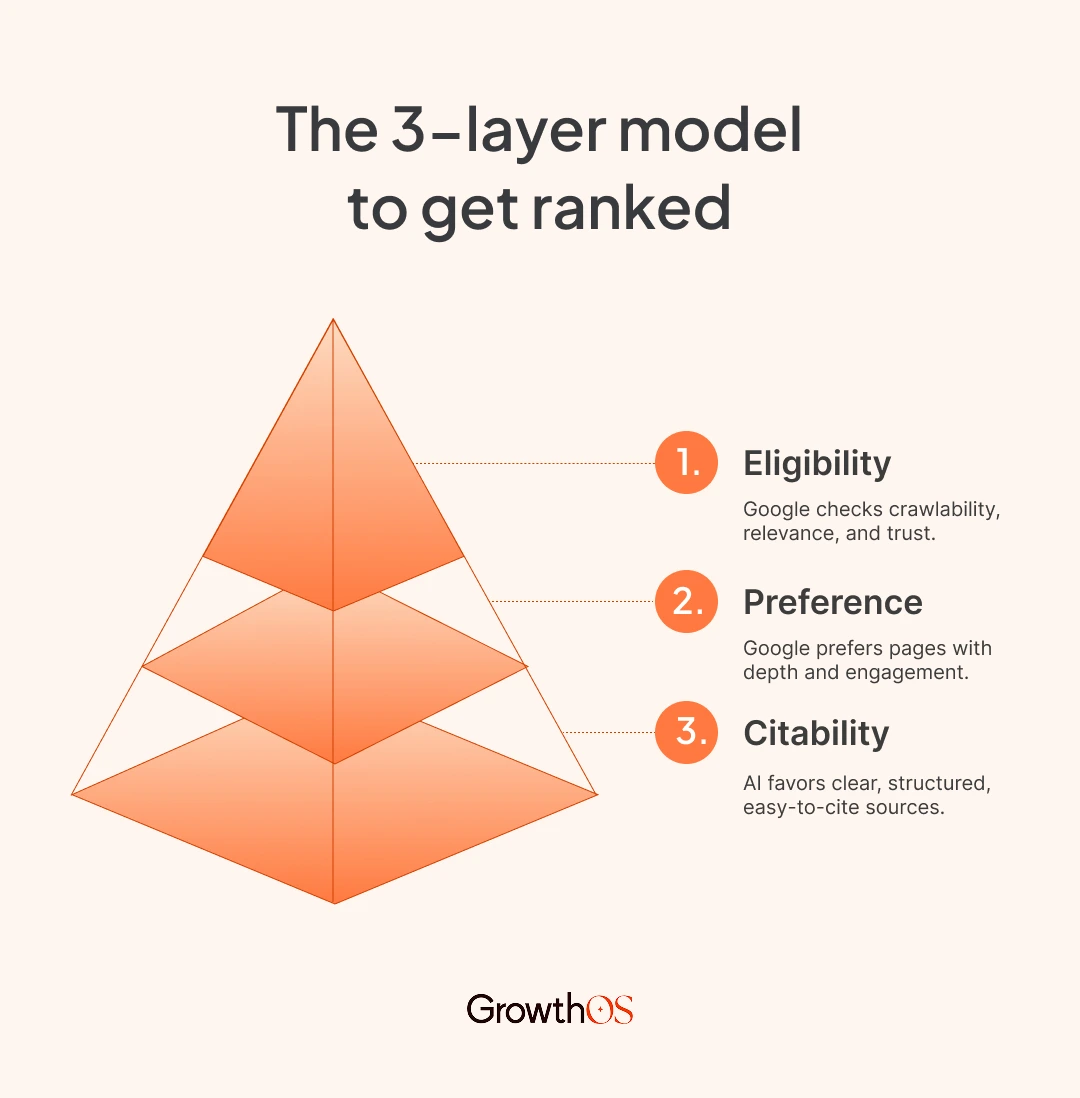
If you try to optimize for a dozen signals independently, you will get overwhelmed. A cleaner way to think about it is in three layers, each building on the one before it.
The first layer is eligibility. Google has to decide whether your page is even a candidate to rank. That means crawlability, basic relevance, and trust. If this layer is weak, nothing else matters.
The second layer is preference. Among all eligible pages, Google has to decide which ones look like the best choice for a given query. This is where click behavior, engagement signals, and content depth start carrying more weight.
The third layer is citability. When an AI Overview is triggered, Google needs sources that are easy to extract from and safe to cite. This is where structure, factual density, and content clarity become a competitive advantage.
Most teams optimize for layer one, occasionally for layer two, and almost never for layer three. That is why strong content still gets invisible in AI answers even when it ranks well organically.
Signal 1: Relevance to Intent
This is the most foundational signal, and also the one most teams get wrong. They pick a keyword, write content around it, and assume they have done the job. But Google is not ranking keywords. It is ranking solutions to problems.
Take a query like "AP automation ROI." Someone searching that is not asking for a definition of AP automation. They want to know whether the business case is real, what the payback period looks like, and what tradeoffs they should weigh before committing. A page that does not answer those questions directly, in that order, will struggle to hold rankings regardless of how well it scores on technical signals.
Intent match also affects AI Overview eligibility. Google's own guidance makes clear that AI Overviews prioritize sources that reduce the risk of missing context. A page that answers the main question and stops there is unlikely to be cited when an AI needs to synthesize a complete answer.
How to Read Intent Properly
A useful test: read the query as a decision someone is trying to make, not as a phrase to target. Then write the page like you are helping a knowledgeable buyer make that decision. Ask yourself what the three follow-up questions are going to be, and make sure the page answers those too.
💡 Pro Tip: Open the top five ranking pages for your target query. Look at the format and the specific sub-questions each one answers. That pattern is the intent blueprint. If your page does not match it, intent signals will work against you even if your content is technically stronger.
Signal 2: Keyword Matching
There is a recurring myth in SEO circles that keyword matching is dead and semantic understanding has replaced it entirely. That is not accurate. Under oath during the Google antitrust trial, Google VP of Search Pandu Nayak described a first-stage retrieval system built on inverted indexes, which are traditional information retrieval methods that predate modern AI. Court exhibits from the remedies phase reference Okapi BM25, the canonical keyword-matching algorithm that Google's system evolved from.
BM25 scores documents based on three things: how often a term appears in the document, how rare that term is across the entire index, and how long the document is relative to average. The first gate your content has to pass is still word matching. Neural networks and semantic models operate on the smaller candidate set that keyword retrieval produces, not on the entire index.
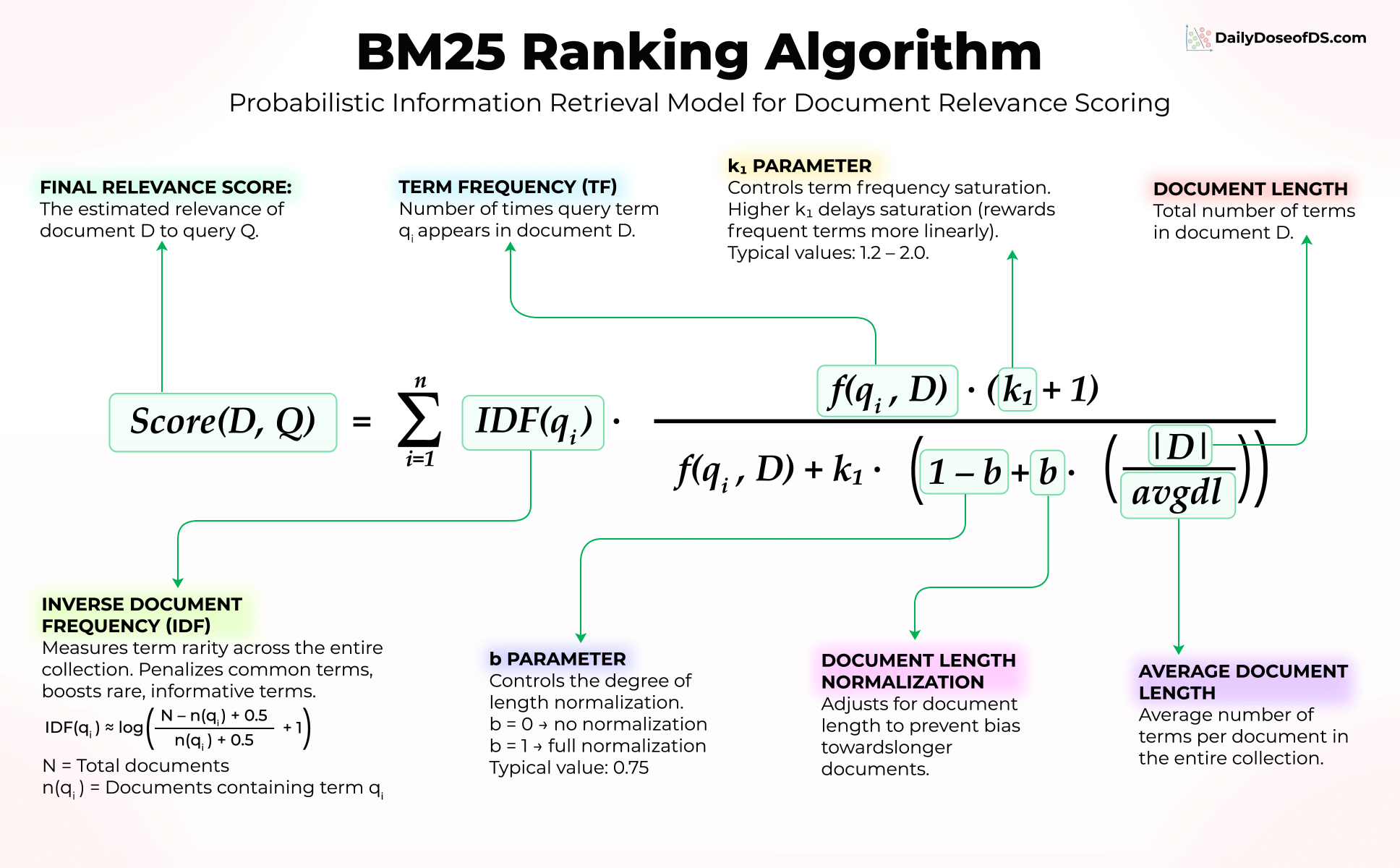
What this means in practice: keywords in titles, H1s, and early H2s still matter. Not because you are "stuffing" them in, but because they help Google immediately confirm what the page is about. If your primary topic is not visible in the first structural elements a crawler reads, you are starting behind.
Keyword placement is now a clarity tool, not a ranking hack. The primary term still belongs in your title tag, H1, and at least one early H2. But the goal is to help Google and the reader confirm they landed on the right page, not to hit a frequency target. If your content is written clearly and the language matches what real buyers search, keyword alignment tends to take care of itself.
Signal 3: Topic Coverage and Semantic Depth
Once Google's keyword matching layer narrows the candidate set, more advanced models evaluate semantic depth. Google uses dense vector embeddings (via its Gecko model) and a cross-attention model called Jetstream to understand not just what the page is about, but whether it covers a topic comprehensively enough to be useful.=
Gecko works in vector space, which means it can recognize that "how to run Instagram ads" and "Instagram ads tutorial" are the same query even if they share no exact words. Jetstream goes further: it understands context, relationships, and negation. It can tell the difference between "best no-code CRM" and generic CRM content, and it understands that "avoid X" is not an endorsement of X.
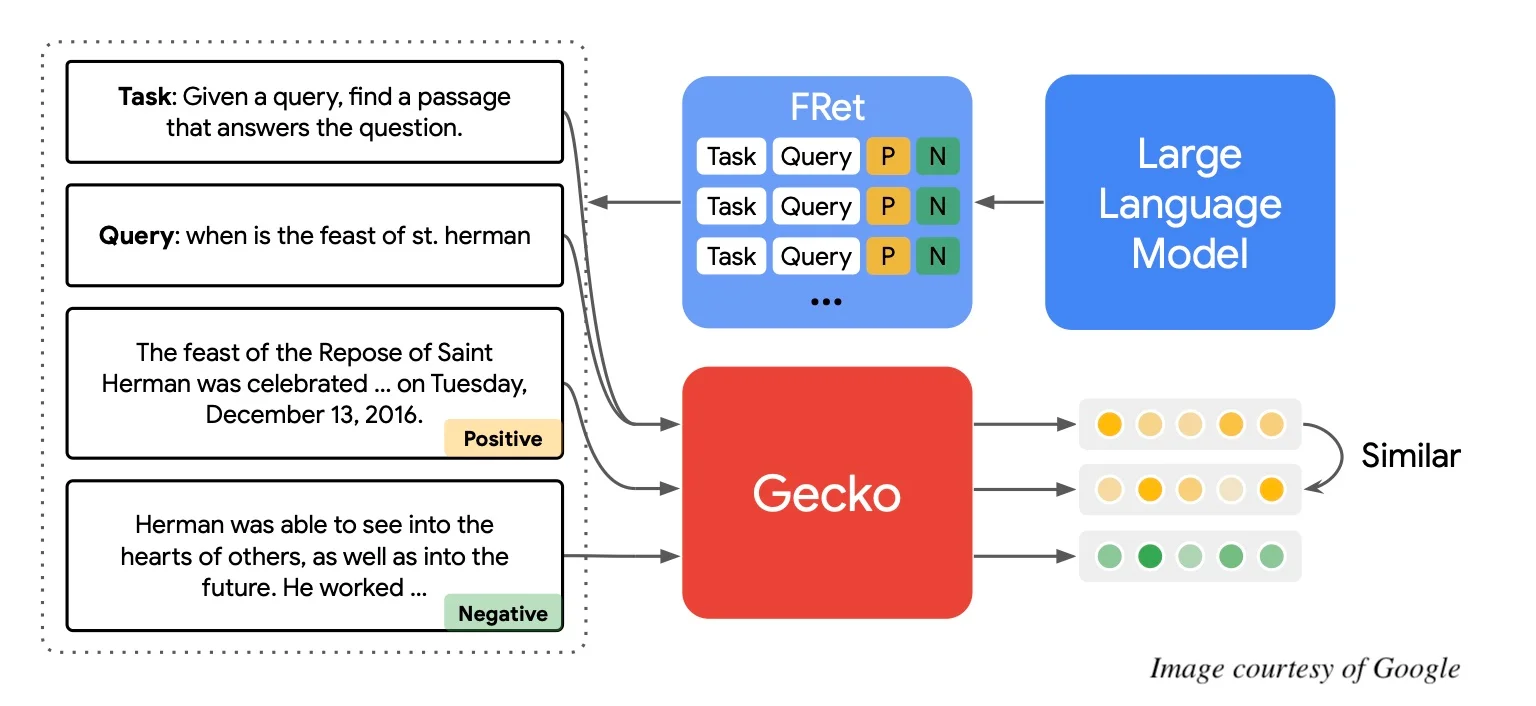
This is where most SEO content falls short. It answers the main question and stops there, ignoring the second and third questions the reader is going to ask next. A page that requires the reader to go back to Google to understand the basics is not providing the semantic completeness these models reward.
What "Semantic Depth" Looks Like in Practice
A well-structured, semantically complete page on a B2B topic typically covers:
- A clear definition of the core concept
- How it works, step by step or with a process breakdown
- Comparisons with alternatives or related approaches
- Common objections, edge cases, and trade-offs
- Practical examples that feel drawn from real work
- FAQs that map to real follow-up queries
This is also why AI-cited articles cover 62% more facts than non-cited ones, according to a Surfer SEO analysis from late 2025. Factual density and topical completeness are what make a page extractable, not just rankable.
Signal 4: Predicted Click Through Rate (CTR)
Google does not only look at historical click data. It actively models which result is likely to get clicked in a specific context, factoring in the query, the device, and the SERP layout. This is called Predicted CTR, and it directly influences ranking decisions before any clicks happen.
Think of it this way: your title tag and meta description are not just labels for humans. They are training data for a behavioral model that predicts whether a user will engage with your result. If your result consistently gets skipped in favor of competitors, that signal accumulates over time and works against you.
The stakes here are higher than they used to be. Research from Seer Interactive found that brands cited in AI Overviews earn 35% more organic clicks and 91% more paid clicks compared to non-cited competitors. This means the relationship between AI visibility and click behavior is now compounding: being cited improves CTR, improved CTR feeds PCTR models, and stronger PCTR scores improve ranking and citation eligibility.
Writing Titles and Descriptions Like a Media Buyer
A strong title tag is not about being clever. It is about being specific enough that the right reader immediately sees themselves in it. A strong meta description is not about keywords. It is about setting expectations clearly so the click is earned, not accidental.
Formats that tend to perform well for B2B and SaaS queries:
- Specific outcomes: "How [X] Reduced CAC by 40% with [Approach]"
- Framing comparisons: "[X] vs [Y]: Which One Actually Scales?"
- Practical depth signals: "A Step-by-Step Framework for [Topic]"
- Decision support: "What to Look For When Choosing [X]"
Treat every title test like a paid ad test. The feedback loop is slower, but the model works the same way.
Signal 5: User Satisfaction and Engagement
Even if Google does not treat every behavioral metric as a direct ranking input, the patterns still matter in aggregate. Pages that cause users to bounce quickly, not scroll, or return immediately to search are not doing their job. Over time, consistently poor engagement quietly erodes ranking stability.
This is where most SEO writing fails in a specific way: it is structured like an essay, not like a tool. Long intros, vague subheads, and answers buried under paragraphs of setup all contribute to early abandonment. The fix is not making content longer. It is structuring content so the reader can extract value fast, then go deeper if they want to.
There are a few structural and editorial choices that consistently improve engagement quality, not just time-on-page:
1. Answer first, then explain. Start each section with the most important point, not the setup to the most important point.
2. Use concrete examples. Readers stay longer when examples feel like they came from real work, not from a textbook. A specific scenario with numbers is worth three paragraphs of abstract explanation.
3. Make it scannable without being shallow. Clear subheads, short paragraphs, and visual anchors (tables, examples, callout blocks) help readers navigate without reducing depth.
4. Internal links that add value. Linking to genuinely related content keeps users on-site and signals topical depth. Linking just for SEO purposes does neither.
Signal 6: E-E-A-T and Trustworthiness
Experience, Expertise, Authoritativeness, and Trustworthiness (E-E-A-T) has been part of Google's quality evaluation framework for years. But its practical weight has increased substantially as AI-generated content has flooded the web.
Google's quality rater guidelines are explicit that E-E-A-T is not a single algorithmic signal. It is a composite assessment drawn from many things: author credentials and biography, the quality of sources cited on the page, the reputation of the domain in its category, and whether the content demonstrates genuine first-hand knowledge rather than surface-level synthesis.
For B2B and SaaS content, the "Experience" component added in late 2022 is particularly relevant. SEO trend analysis from several 2025 algorithm update cycles suggests that content without demonstrable first-hand expertise is increasingly being filtered before the AI Overview citation pool is even considered.
Signal 7: Content Extractability and Structure
This is the signal that catches most teams off guard, because it requires thinking about content differently than traditional SEO does.
AI systems do not summarize your page the way a human reader would. They look for clean, self-contained answer blocks they can pull without losing meaning. Research cited by Search Engine Land suggests that a significant share of LLM citations come from the first 30% of a page. That matches what practitioners observe: answers buried under long intros or buried inside heavy prose rarely make it into AI summaries, regardless of how accurate or well-written they are.
The implication is structural. If your content requires context from three other sections to make sense, it is hard to extract. If it is written with self-contained answer blocks at the section level, it is much easier to cite.
A Content Structure That Works for Both Humans and AI
For most B2B informational pages, a format that serves both traditional ranking and AI extractability looks something like this:
- A short, direct answer to the main question in the first 50 to 70 words of the intro
- H2 sections that map to distinct sub-questions a buyer would ask
- A definition or "what it is" block at the start of each major section
- A practical "how it works" or step-by-step breakdown after the definition
- An FAQ section near the bottom that addresses common follow-up queries
- Schema markup (FAQ, HowTo, Article) on the pages most likely to trigger AI Overviews
The goal is that any section of your page, read in isolation, still makes sense and still answers something. That is what makes content citation-ready.
Signal 8: Freshness
Freshness is a signal that matters most when the information is actually time-sensitive. Google applies a recency score to favor newer or recently updated content for queries where the answer changes. This affects categories like software tools, pricing, regulations, compliance requirements, tax guidance, and any content using language like "best," "top," or a specific year.
The pressure from AI Overviews makes this worse. Google wants to cite sources that feel current and safe. A page with a "last updated" date from 18 months ago and no visible changes is a liability compared to a similar page refreshed within the last quarter, even if the underlying content quality is comparable.
Building a Refresh Cadence That Works
A practical approach is to categorize your content by decay rate:
Fast-decaying (quarterly refresh)
Tool roundups, pricing comparisons, "best X" lists, regulatory guidance, and anything referencing a specific year.
Medium-decaying (every 6 months)
Thought leadership pieces with statistics, comparison frameworks, and category-specific strategy content.
Slow-decaying (annually)
Core definitional content, foundational guides, and how-to material where the fundamentals do not change.
When you refresh, the update should be substantive. Adding a new section, updating a statistic with a current source, or adding a new example signals to Google that the page has been meaningfully reviewed, not just touched. A cosmetic date change without content changes is unlikely to move freshness scores.
Signal 9: Page Experience
Even the best content fails if the page is frustrating to use. Page experience is not a separate SEO track from content strategy. It is the container everything else runs inside.
The numbers are unambiguous. Google's own mobile research found that 53% of mobile visitors abandon pages that take longer than three seconds to load. That is not an SEO trivia stat. It is a business problem. If half your mobile audience bounces before engaging, your behavioral signals are suppressed before the content even gets a chance.
Core Web Vitals and What Actually Moves Rankings
Google uses Core Web Vitals as the primary technical health signals for page experience. The three that matter most for content pages:
Beyond Core Web Vitals, a few things consistently matter for content performance on B2B and SaaS sites:
- Mobile readability without pinch-zoom on charts, tables, or code blocks
- No aggressive interstitials or pop-ups that cover the main content
- Clean internal link architecture so related pages reinforce topical depth
- Stable, logical breadcrumb trails that help both crawlers and users navigate
How to Prioritize When You Cannot Do Everything at Once
Nine signals sounds like a lot. In practice, most B2B and SaaS content has a small set of issues that are suppressing performance across multiple signals at once. A page that fails on intent match will also fail on engagement. A page without extractable structure will fail on citability. Fixing root problems tends to lift multiple signals simultaneously.
If you are starting from scratch or trying to decide where to focus, work in this order:
Start with pages closest to revenue
Pages targeting high-intent queries, or those already ranking between positions 5 and 20, have the most to gain from optimization across these signals.
Fix intent match first
If the page is not clearly answering the right question in the right format, no amount of technical or structural optimization will fully compensate.
Add a strong extractable lead
Put a direct 50-70 word answer to the primary question in the first visible section, before any preamble.
Fill the missing follow-up sections
Identify the two or three questions your reader will have after the main answer, and add sections that address them.
Improve title and meta for specificity
Treat them like ad copy. What does a buyer in the decision stage want to see before they click?
Fix the biggest UX issues on mobile
Run the page through PageSpeed Insights, target anything pushing LCP above 2.5 seconds or causing layout instability.
Refresh any statistics or examples older than 12 months. Freshness signals matter most for pages targeting time-sensitive queries, but a visibly outdated stat anywhere undermines trust.
Work With Us to Boost Your SEO Performance
Traditional SEO got you to a list. What is required in 2026 is getting into the answer itself. That means building content that is not just relevant, but eligible, engaging, and structured in a way Google can safely extract from.
Most SEO programs are still optimizing for one or two of these signals in isolation. The teams that are pulling away are the ones treating it as a system: intent, coverage, extractability, credibility, and experience all working together.
At GrowthOS, we build SEO programs around all of these signals. We are operators, which means we run the plays ourselves, across content architecture, SERP asset optimization, AI citation targeting, and technical fixes, before recommending them to clients. If you want an honest look at where your current content falls short and a clear plan for what to do about it, book a discovery call with our team. We will show you exactly what is holding your rankings back.

Pritesh Jagtap
Founder
Pritesh Jagtap is the founder of GrowthOS, where he helps startups and creators scale through growth systems, content, and SEO/ GEO strategies. With a background spanning growth, marketing, and operations, he’s passionate about building frameworks that drive sustainable results. Beyond GrowthOS, he experiments with creative projects, explores moutains trails and be around offline communities.

More insights
Get Growth Insights Delivered to Your Inbox
Join B2B marketers getting weekly strategy breakdowns on SEO, AI search, PPC, and YouTube—straight talk, no generic advice.
Oops! Something went wrong while submitting the form.




.svg)