
We'll discuss your goals, current challenges, and how our process can help to drive real business growth.
SEO
How to Rank in AI Overviews: 5 SEO Best Practices to Follow Right Now
Taher Batterywala
December 9, 2025
12 min
.webp)
TABLE OF CONTENTS
AI Overviews are those AI-generated summaries you now see at the top of search results. It's Google's next big leap in how we search.
Instead of showing a list of links, they generate quick, conversational summaries pulled from multiple sources, right at the top of the results page. This means, the search behaviour is being redefined fundamentally and will be totally different from what we used to do a couple of years ago.
According to Pew Research, 18% of Google searches in March 2025 included an AI Overview. Among those users, only 8% clicked on any result link, and just 1% clicked on a link inside the summary itself.
That means visibility isn’t about ranking #1 anymore. It’s about being referenced.
If your content isn’t structured in a way that AI can understand and cite, you’re not just losing traffic, you’re disappearing from the top of the funnel.
In this article, we will break down how AI Overviews work, why they matter, and what to do right now to make sure your content shows up in them.
TL;DR
To rank in AI overviews, follow these 5 key SEO best practices:
1. Structure your content for AI intent and readability: Break down topics by sub-intent, include direct answers, and format your content using headings, lists, and semantic HTML to make it LLM-friendly.
2. Implement structured data to aid AI understanding: Schema markup helps LLMs and Google understand what your content means, not just what it says. This helps to boost CTR and visibility across AI surfaces.
3. Establish content credibility through E-E-A-T: Prioritize experience-led content, cite reputable sources, and show authorship. This is critical for YMYL pages and AI snapshot selection.
4. Strengthen off-page authority and visibility: Build links from trusted sources, get listed on review platforms like G2 or Capterra, and increase your brand’s digital footprint across credible clusters.
5. Fix crawlability issues and publish an llms.txt file: Ensure your pages return a 200 status, aren’t blocked from indexing, and include an llms.txt file to guide LLMs to your highest-value content.
How AI Overviews Are Dominating Google Search
AI Overviews are now the most prominent feature on Google Search.
They show up above everything: ads, top 10 organic results, and they have even started to replace featured snippets. Powered by Google’s Gemini model and built on its earlier SGE experiment, they use generative AI to create instant summaries from multiple sources.
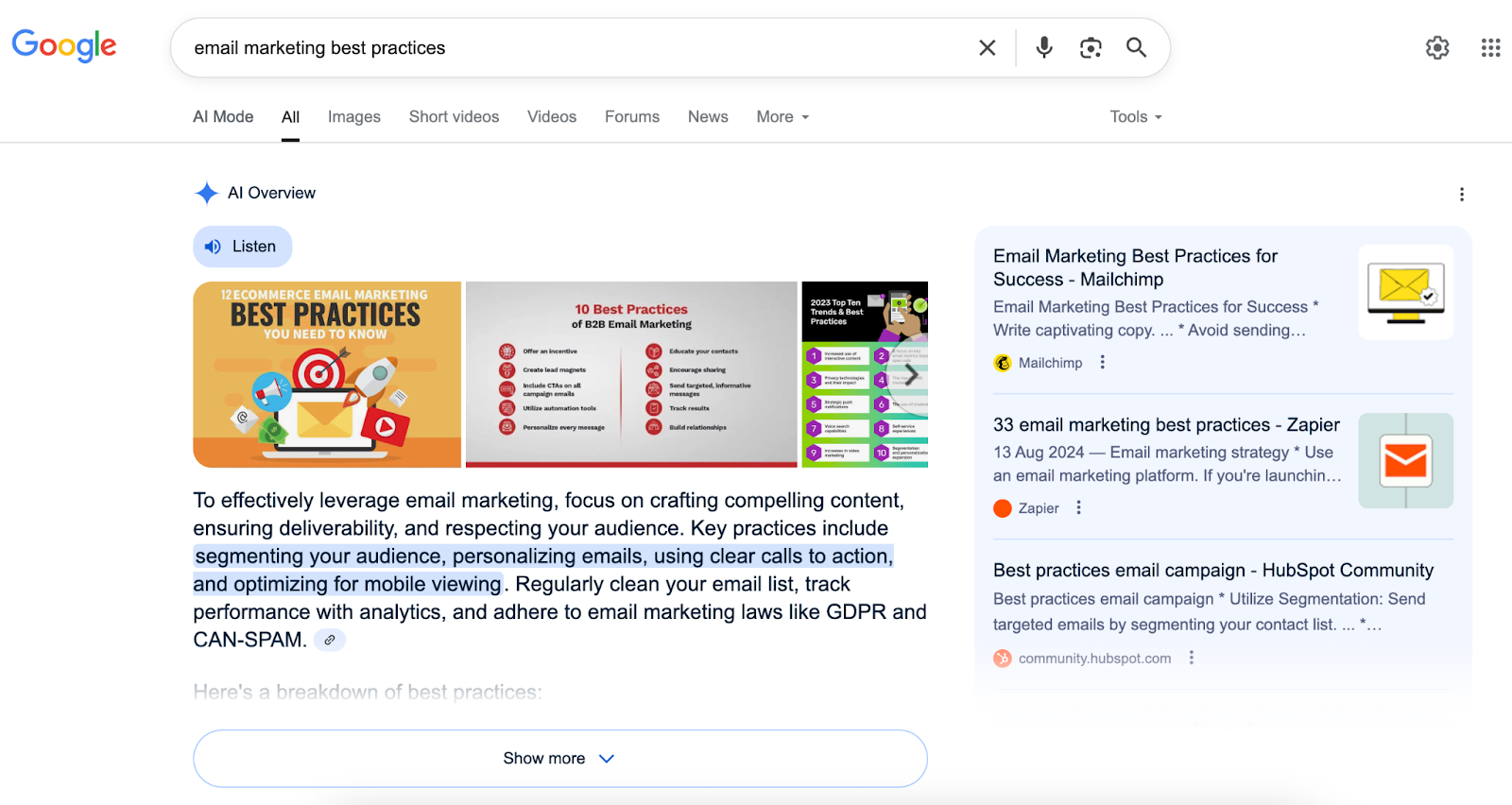
Unlike featured snippets, which usually cite one page, AI Overviews pull data from a broader pool using techniques like query fan-out, which surfaces multiple subtopics and sources at once. That means more opportunities for your content to be cited, but only if it’s structured well.
A Surfer SEO study of 400,000 queries found that 52% of AI-cited content came from the top 10 organic results, but not always from the top 3. So ranking high helps, but clear structure and relevance matter more.
According to Google, there’s no special markup or schema needed to qualify for AI Overviews. If your content is indexable, crawlable, and follows core SEO best practices, it’s eligible.
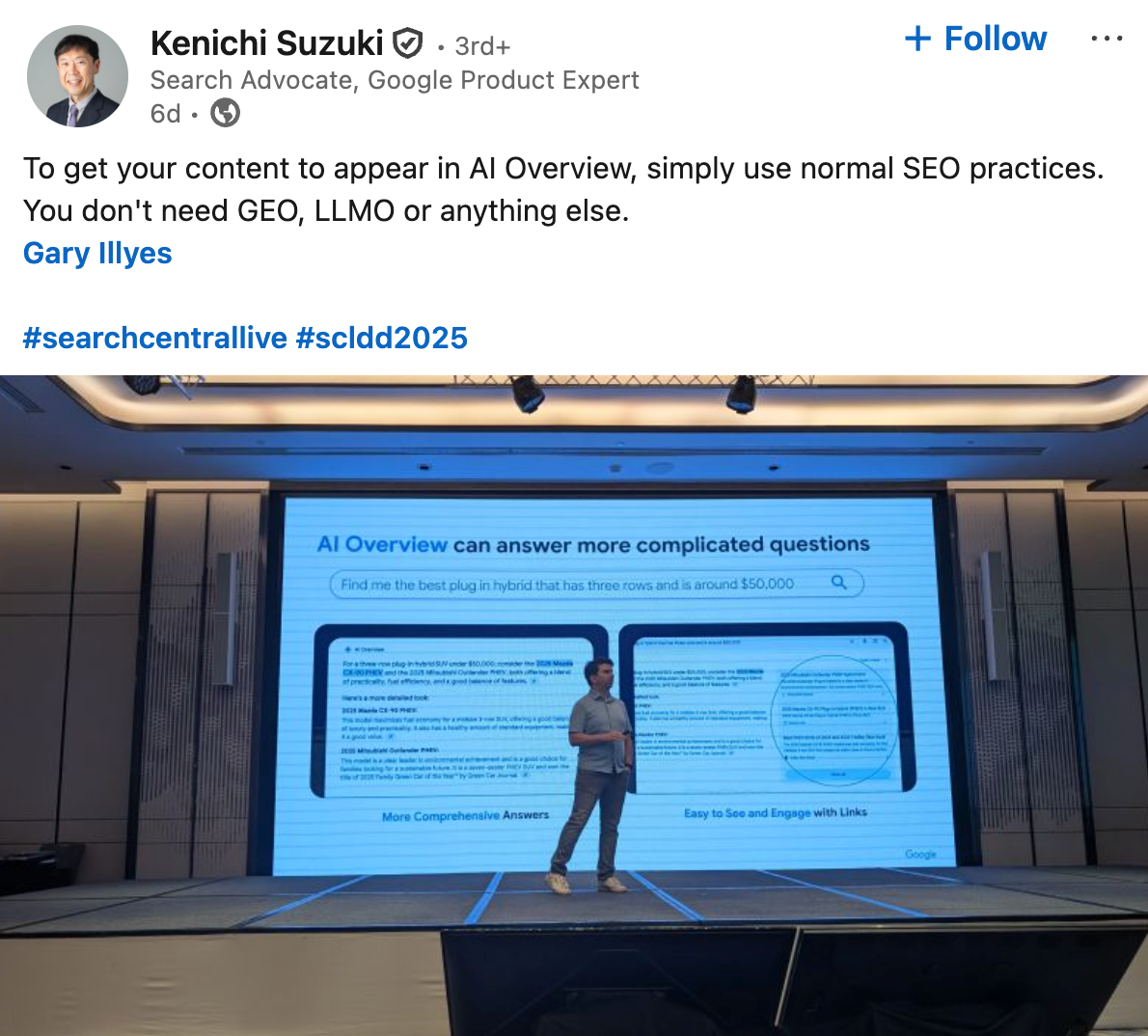
Gary Illyes, analyst at Google cements this in the latest Search Central Deep Dive event.
“To get your content to appear in AI Overview, simply use normal SEO practices. You don’t need GEO, LLMO or anything else.”
And that’s why it’s non-negotiable to follow these five SEO techniques to launch your content into AI Overviews.
Best Practice #1: Structure Your Content for AI Overview Intent and Readability
If you want to be cited in AI Overviews, your content needs to speak the same language as the model, literally. That means structuring it in a way that AI can parse, extract, and repurpose without needing context.
Lead with a Summary-First, Answer-Oriented Introduction
Google’s AI Overviews don’t summarize your entire page. They pull precise phrases and paragraphs that answer the query clearly and quickly.
That means each section of your page or article needs to act like a direct answer: short, self-contained, and relevant.
For example, if your page targets “What is multi-touch attribution?”, lead with:
“Multi-touch attribution is a model that credits multiple marketing touchpoints for a single conversion.”
These types of direct definitions are highly favored by AI Overviews and large language models because they’re clean, factual, and easy to extract.
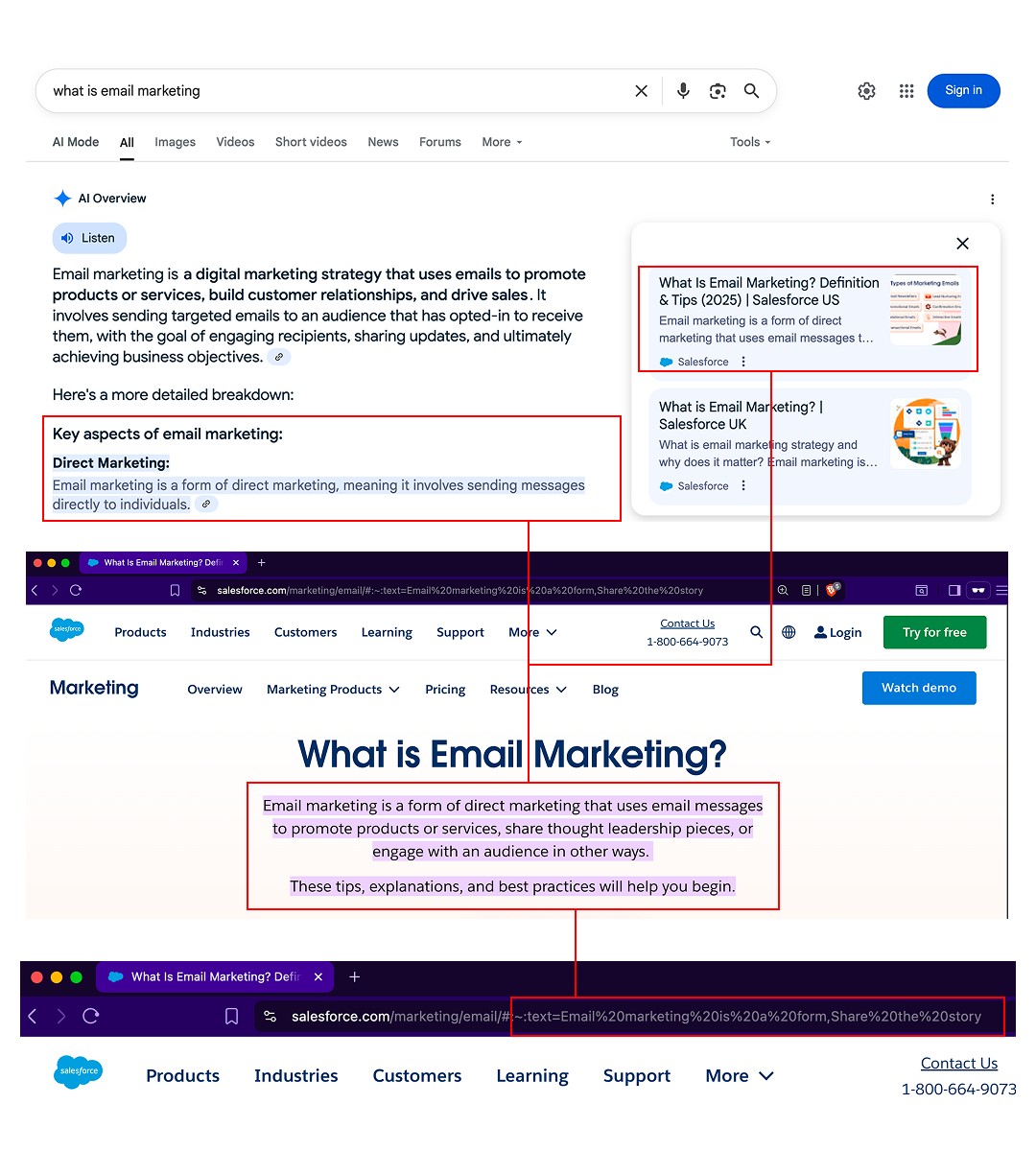
They also increase your chances of being referenced via Text Fragment linking, Google’s system that uses #:~:text= URLs to jump users directly to relevant parts of a page as shown below.
Match the Structure AI Systems Expect
AI-generated summaries are fundamentally different from how humans read full articles.
They rely on modular comprehension, meaning they isolate chunks of content and determine relevance without needing the rest of the page for context.
Your job is to make those chunks easy to parse.
How? Format based on the query intent:
Use clear H2 and H3 tags. Under every subheading, begin with a 1–2 line summary sentence that can stand on its own. If an LLM pulled only that line, would it still be useful? That’s your bar.
Pro Tip: Before you write summary-intros, ask the same question that you want to target in tools like ChatGPT or Perplexity. See what kind of answers you get, observe the content that gets pulled up from competitors. Then write in a similar fashion, but add a little extra detail to win your place in AI Overviews.
Example:
What are the pros and cons of a headless CMS?
A headless CMS offers flexibility and speed, but it requires more developer resources to implement and maintain.
Then elaborate below with more detail.
Avoid long paragraphs, jargon-heavy intros, or content that forces the AI to “read between the lines.”
Also: use lists, tables, and short bursts of text. Surfer SEO found that 78% of AIOs include list formats because they map cleanly to how LLMs structure summaries.
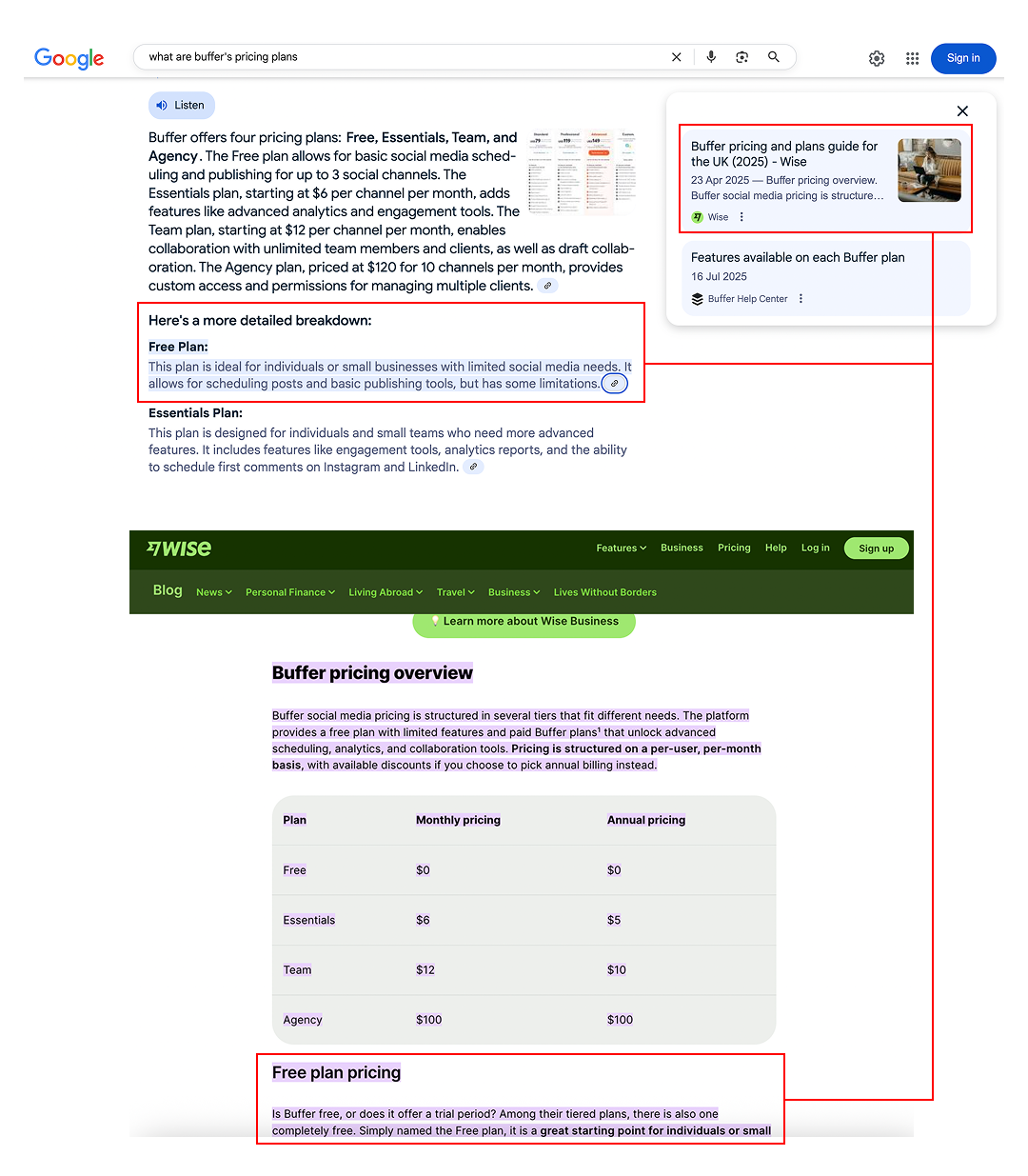
When you search for “what are buffer's pricing plans” surprisingly, Google features information from Wise’s article on Buffer’s pricing and plans.
Eliminate Conflicts and Redundancy
AI models skip clutter. They won’t cite content if your page contradicts itself or buries the main point.
Here’s a common example:
A blog titled “How to improve website speed” might say early on,
Using a CDN is the best way to reduce latency.
But 800 words later, it says:
Switching to static hosting is the most effective way to improve page speed.
These contradict each other. Even if both are technically valid, AI models don’t want to infer nuance. They prefer definitive, unified explanations.
Consolidate the best answer in one place. Don’t repeat definitions in multiple sections. Remove legacy or conflicting info that can confuse LLMs.
Example:
If you have a “Pros and Cons” section, don’t scatter pros across different headings. List them cleanly, in one place. Use clear labels like:
- ✅ Pros of server-side rendering
- ❌ Cons of server-side rendering
And keep everything in sync with what you say elsewhere on the page.
AIOs reward clarity and structure. The more precise your framing, the better your citation odds.
Best Practice #2: Leverage Structured Data & Schema to Help AI Understand Your Content
AI systems rely on patterns. Schema helps reinforce those patterns by labeling the purpose of your content like what it is, how it’s structured, and why it matters. When done right, it acts as a cue for relevance.
Use the Right Schema Types to Trigger AI Inclusion
Structured data helps Google interpret your content more precisely. While AI Overviews don’t require schema to feature your page, Google has confirmed that it uses structured data to support how AI models like Gemini understand and prioritize content.
So if you want to improve your odds of being cited in AI Overviews, your schema should clearly communicate the purpose and structure of your page.
Start by adding schema types that align with AI-friendly formats:
- FAQ: Ideal for question-answer formats. Each FAQ pair becomes a self-contained data point AI can use.
- HowTo: Works well for instructional content, especially step-by-step guides.
- Article: Tells Google your content is authoritative and editorial in nature.
- Breadcrumb: Helps AI models understand site hierarchy and context.
Use JSON-LD, which is Google’s preferred format for clean, scalable markup that doesn’t interfere with your page’s HTML. If you use WordPress or Shopify, plugins like Yoast SEO, Rank Math, or Schema Pro simplify this process. But if you have a custom tech stack, you can use Dentsu’s schema markup generator tool.
Pro Tip: Add custom @type extensions in JSON-LD for niche use cases, even if not officially listed in Google's documentation. Schema.org supports extensible vocabularies. So if you’re in a complex vertical (e.g. compliance, real estate, education), defining a more specific @type can help AI models better disambiguate context when they crawl broader content clusters.
Before pushing live, run your page through the Schema Markup Validator to check for errors. Even minor issues (like missing required fields) can make your markup ineligible.
Avoid Schema Misuse or Mismatch
Schema is not a shortcut to visibility. It supports good content, but it doesn’t fix bad structure or weak writing.
Here’s what not to do:
- Don’t markup what’s not on the page. If you add FAQ schema but the questions and answers aren’t visible to users, it violates Google’s guidelines.
- Don’t copy-paste generic schema. Tools that generate one-size-fits-all markup often miss required fields or mislabel the content type.
- Don’t overload with every schema type. Stick to what’s relevant for that specific page.
Let’s say you have a guide titled "How to Conduct a Technical SEO Audit."
✅ You can use:
- HowTo schema for the step-by-step process
- Article schema to define it as editorial content
- Breadcrumb to clarify its position in your site structure
❌ But don’t:
- Add Product schema unless you're selling a service on that page
- Insert Review schema if the page doesn't contain user-generated or editorial reviews
Also, keep your schema aligned with the headings and content structure. If your subheadings are poorly labeled or inconsistent, the AI may struggle to connect schema entities with on-page information.
Why This Matters for AI Overviews
Structured data won’t guarantee you a spot in AI Overviews, but it can give AI models clearer signals.
As confirmed at Search Central Live Madrid, structured data helps models like Gemini disambiguate context, identify core entities, and recognize intent faster. That can tip the balance in favor of your content when multiple pages offer similar information.
And it’s not just theory. Results as presented by Google for leading brands show its impact:
- Rotten Tomatoes saw a 25% higher CTR on structured pages
- The Food Network saw a 35% traffic lift after schema adoption
- Nestlé reported 82% higher CTR on rich result pages
Even if AI Overviews rewrite your content into summaries, schema ensures you’re in the data pipeline.
In short: prioritize structure and clarity first, then reinforce it with schema. Used correctly, it can make your content more “understandable” to AI systems and more likely to be cited.
Best Practice #3: Keep Content Concise, Scannable & AI‑Friendly
AI Overviews don’t just care about what you say; they care about how it’s delivered. Your formatting, sentence structure, and pacing all influence whether your content is considered usable by LLMs.
That means writing less like an essay and more like a well-organized reference document.
Use Modular, Scannable Structure
The more visually segmentable your content is, the easier it is for AI systems to identify individual concepts, subtopics, and answer blocks.
Every heading should introduce a tightly scoped idea. Every list should serve a single function. Every paragraph should answer one question.
Good modular structure looks like this:
H2: Choosing the Right CRM
H3: Key Features to Look For
H3: Best Options for SMBs
H3: Cost Breakdown by Vendor
Each section can stand alone. That’s what makes it AI-friendly. If your headers are vague or your paragraphs try to do too much, your content becomes harder to quote.
Break content into easily readable and scannable chunks.
✅ Numbered lists for steps
✅ Bullets for comparisons
✅ Tables for comparisons
These microstructures match how LLMs render data.
Maintain High Readability
Readability isn't just about sentence length. It’s about how quickly a user (or AI) can extract value.
AI Overviews favor content that feels frictionless. If your language forces cognitive strain through dense phrases, compound ideas, or filler, you’re less likely to be included.
Instead of aiming for minimum reading level, aim for maximum clarity. This includes:
- Avoiding intro fluff (“In the ever-changing landscape of…”)
- Front-loading sentences with the key insight
- Writing with rhythm (mix long and short lines for flow)
- Formatting micro-ideas into separate lines instead of stuffing them into one block
Bad example ☹️
“A strong call-to-action at the end of your newsletter copy is essential to convert leads and guide users toward your desired outcome.”
Good example 🙂
End your newsletter with a strong CTA. It nudges readers to take action.
Pro Tip: Track your scroll depth and average time-on-page for long-form content using GA4. If users consistently drop off before finishing key sections, it’s a sign your structure might be overwhelming, not just for humans, but for AI too.
Best Practice #4: Build Authoritative, E-E-A-T-Optimized Content
AI Overviews are more selective with sources than traditional search. It's not enough to rank well. You need to signal expertise, credibility, and real-world experience.
LLMs are trained to recognize those signals at both the content and domain level. If your site lacks trust indicators, you’re unlikely to be quoted, no matter how strong your SEO is.
Prioritize Credibility Over Keyword Density
Google’s guidelines are clear: people-first content wins, especially in sensitive niches like finance, health, and legal. AI Overviews follow the same logic.
Instead of stuffing in keywords, build content that demonstrates authority. Here’s how:
- Cite original data: If you conducted a survey, share methodology and results.
- Quote known experts: Attribution matters because LLMs trust names with digital footprints.
- Use credible third-party sources: Link to CDC, OECD, or peer-reviewed research when making claims.
Also, don’t bury your authorship. Add detailed bios, list credentials, and link to public profiles. Google’s quality raters (and AI models) look for who created the content, not just what’s in it.
Link Out to Top-Tier Sources Strategically
Citing credible sources doesn’t just support your argument, it places your content in a high-authority “neighborhood.”
This matters more than most think.
If you’re publishing medical or legal content, reference established institutions (e.g., Mayo Clinic, IRS.gov). For AI models trained on citation networks, proximity to trusted domains increases your own perceived authority.
Use outbound links to:
Back up facts with evidence
E.g. If you claim “remote work improves productivity,” link to a reputable study from Harvard Business Review.
Clarify technical or sensitive topics
E.g. Writing about tax deductions? Link to the relevant IRS page.
Strengthen trust for YMYL content
E.g. For health advice, cite the CDC or WHO, not generic blogs.
Avoid linking to aggregator sites, forums, or vague blog posts, especially if they lack bylines or sourcing. AI models recognize the difference.
Distribution and Content Visibility Across Different Sources
Here’s the piece most SEOs overlook: AI Overviews pull signals from beyond your blog.
You might have a brilliant piece of content, but if your brand isn’t present across trusted ecosystems, you’ll stay invisible.
Focus on building presence in three key areas:
Review platforms:
List your product or service on G2, Capterra, Clutch or TrustRadius. ChatGPT and Perplexity frequently source summaries and rankings from these databases, especially for comparison queries like “best CRMs for agencies.”
Authoritative backlinks:
Secure links from respected publications or blogs in your niche. For example, a guest post on Moz or Content Marketing Institute not only helps SEO, it tells AI models that your name appears in trusted contexts.
Public mentions and co-citations:
Take part in expert roundups, industry podcasts, or byline interviews. Tools like SparkToro can show where your audience engages the most. Try to get featured there. LLMs use these signals to determine domain-level authority.
Pro Tip: Run your brand or product name through Perplexity and ChatGPT using queries like “top [category] tools” or “what is [your brand] known for”. If you don’t show up, or worse, the answer is pulled from outdated forums or aggregator sites, it’s a sign your off-page presence needs work. Use this as a visibility audit and prioritize high-signal sources where AI models already look.
Best Practice #5: Fix Technical SEO Errors That Block AI Indexing
No matter how good your content is, AI systems can’t cite what they can’t access. Broken links, JavaScript-heavy delivery, or blocked pages might not affect what humans see—but they can completely shut you out of generative AI search.
Before you optimize for AI visibility, you need to make sure AI crawlers can actually reach and understand your content.
Ensure Crawlability & Accessible Indexing
Start by confirming the basics: your key pages should return a 200 HTTP status, not 404s or 302s. Pages set to noindex won’t show up in Search or AI Overviews.
Use Google Search Console → Indexing → Pages to check for crawl errors or indexing issues. Prioritize fixing:
- Pages marked noindex or blocked by robots.txt
- Thin or low-value content that offers no unique insight
- JavaScript-rendered pages that don’t load without user interaction
Generative AI tools, like Gemini or Claude, can miss content if it’s hidden behind JS frameworks or client-side rendering. If you rely on React or Vue, consider server-side rendering or tools like Prerender.io to generate static HTML snapshots for bots.
👉 Insert screenshot of Search Console showing indexing issues flagged
Also, audit your Core Web Vitals. LLMs favor fast, stable experiences—because slow or incomplete rendering can result in AI skipping your content entirely.
Add & Optimize an llms.txt File for AI Discoverability
As generative AI platforms like ChatGPT, Claude, and Perplexity evolve into primary discovery tools, llms.txt is emerging as a potential game-changer. Think of it as a content map made for machines—a plain text or Markdown file that tells AI exactly what to read and reference on your site.
Unlike robots.txt, which blocks or permits crawler access, llms.txt doesn’t restrict. It curates. It says: “This is what matters on our site. Don’t waste your tokens crawling random JS-heavy pages.”
Here’s a quick comparison of both:
At its simplest, llms.txt can list high-value URLs or Markdown summaries of your most helpful guides, documentation, or resources. But the real power lies in flattening your best content into a full-text format (llms-full.txt) that AI can ingest efficiently—removing distractions like ads, navigation, or JS overlays.
Companies of popular companies that have implemented llms.txt:
- Perplexity includes a flattened version of their docs for better LLM indexing.
- Zapier exposes structured, simplified documentation to AI.
- Anthropic shares precise, ready-to-parse API instructions.
Use a tool like FireCrawl or the Website LLMs WordPress plugin to auto-generate your file, or roll your own with basic Markdown and care.
Best practices:
- Host at yoursite.com/llms.txt (and/or llms-full.txt)
- Include only your most accurate, recent, and helpful content
- Use clear summaries or full text where helpful
- Add a noindex meta tag to the file to avoid index bloat
- Don’t include robots.txt directives—this isn’t meant to block crawlers
Pro Tip: Don’t just list your pages. Rewrite them for LLMs. Keep the language clear and to the point. Highlight key takeaways. Think of your llms.txt as your AI press kit, which is a curated collection of your site’s best insights, written like you’re briefing a CEO who has very little time to read it.
Why it matters:
Most LLMs don’t have the budget (literally, in token costs and latency) to crawl messy, multi-layered websites. llms.txt gives them exactly what they need and fast. That makes your content easier to cite, summarize, and show up in answers across AI tools.
Final Thoughts
AI Overviews aren’t replacing traditional SEO, they’re reshaping how visibility works. Sites that structure content for AI, maintain technical hygiene, and earn trust signals will win more often, and more meaningfully. If your SEO playbook still treats AI as an afterthought, it’s time for a rewrite.
At GrowthOS, we are helping fast-growing B2B brands rewire their SEO for the AI era, strategizing for AI Overviews, optimizing content for machine context, and driving traffic that converts. See how we can help you do the same.
👋 Want to explore what this could look like for your business? Book a free growth discovery call.

Taher Batterywala
Organic Growth Lead
Taher Batterywala is an SEO and Growth Content Marketer. With over 8 years of B2B marketing experience and a diversified skill set, he helps craft winning strategies and execute end-to-end campaigns for B2B and SaaS companies to achieve scalable organic growth. Outside of work, he enjoys watching movies, photography, and dabbling in design. You can find him on LinkedIn and X.

More insights
Get Growth Insights Delivered to Your Inbox
Join B2B marketers getting weekly strategy breakdowns on SEO, AI search, PPC, and YouTube—straight talk, no generic advice.
Oops! Something went wrong while submitting the form.




.svg)