

We'll discuss your goals, current challenges, and how our process can help to drive real business growth.
SEO
How to Build a Winning SEO Keyword Strategy: Step-by-Step Guide
Taher Batterywala
March 11, 2026
10 min

TABLE OF CONTENTS
People no longer type in broad keywords and click the first result. They ask full questions, expect context, and often get answers without leaving the page.
AI overviews now appear in majority of the informational searches, cutting organic clicks by up to 64%. Meanwhile, 33% of search activity comes from AI agents, pushing queries toward conversational and multimodal formats. This shift demands more than old-school tactics.
A forward-looking SEO keyword strategy helps you adapt to that shift. One that aligns with business goals, attracts qualified traffic, and adapts to zero-click results by prioritizing intent over sheer volume.
This guide shows you how to build a keyword strategy that does exactly that.
TL:DR
A keyword strategy is a prioritized plan that selects, maps, and sequences search terms to match user intent and business goals across content and formats.
A strong keyword strategy focuses on intent, AI-friendly formats, and pipeline impact, prioritizing high-value long-tail terms over raw volume for measurable revenue.
Start by defining goals, buyer personas, and funnel stages; then map seed topics into prioritized keyword lists with business value and realistic difficulty.
Cluster keywords into pillar and spoke pages, optimize formats for snippets and AI, and measure impact using conversions, rankings, and AI citations.
AI search demands entity clarity, multimodal assets, and snippet-friendly structures; prioritize long-tail conversational queries that AI agents cite and users actually convert.
What Is a Keyword Strategy?
A keyword strategy is a comprehensive plan for identifying, prioritizing, and optimizing search terms that align with audience intent and business objectives.
It goes beyond mere keyword research, which focuses on discovering terms. Instead, it provides direction on which ones to target first and how to use them across content.
Think of it as the blueprint that turns raw keyword data into results.
Where keyword research tells you what people are searching for, a keyword strategy tells you which of those terms are worth your time, how to target them, and in what order.
For example, “CRM tools” may have 50 times the search volume of “CRM for real estate agents,” but if you're selling a niche product for brokerages, the long-tail term is likely to convert more qualified leads.
Why You Need a Strong Keyword Strategy in 2026
For 2026, a strong keyword strategy helps conquer AI-driven results. Entities and topical authority now outweigh keyword density, as search engines favor comprehensive coverage over stuffed phrases.
Your keyword strategy must now account for:
- AI-generated answers, not just traditional SERPs
- Citation opportunities in platforms like ChatGPT and Perplexity
- Content formats like FAQs, tables, and video summaries that AI prefers to cite
A keyword strategy today helps you:
- Prioritize pages that drive pipeline, not just traffic
- Target long-tail and branded terms AI agents are more likely to cite
- Build topic clusters that reinforce authority across themes
Audience behavior is shifting too. With 35% of Gen Z now preferring AI chatbots over traditional search engines, your keyword strategy has to adapt to how people actually search in 2026.
That means targeting more natural, conversational queries, publishing in formats AI can easily parse and cite, and focusing on precise, niche intent keywords instead of broad terms that attract unqualified traffic.
It’s no longer about ranking first. It’s about being found in the right place, in the right format, by both people and machines.

Step-by-Step Guide to Building a Keyword Strategy
Now that we’ve covered the why, let’s move into the how. This framework is designed specifically for B2B companies that want to generate pipeline, not just pageviews.
Step 1: Define Your Goals and Audience
The first step is clarity. What are you actually trying to achieve with your SEO keyword strategy?
If your goal is brand visibility, your keyword targets and content types will look very different from someone focused on driving demo requests or generating bottom-of-funnel leads.
For most B2B brands, here’s how you can structure this:
1. Align Goals to Funnel Stage
Each stage of the B2B funnel requires a different keyword approach:
- Top of Funnel (TOFU): Prioritize visibility and education. Use broad informational terms that speak to early-stage research (e.g., “what is SOC 2 compliance”).
- Middle of Funnel (MOFU): Focus on solution-aware queries (e.g., “SOC 2 automation platforms”).
- Bottom of Funnel (BOFU): Target keywords with high commercial intent (e.g., “best SOC 2 software for startups”).
High-volume terms at the top might look good in analytics, but rarely convert. A recent Grow and Convert study found that bottom-funnel pages convert at 25x the rate of top-funnel ones (4.78% vs 0.19%).
2. Create Audience Personas Based on Buying Behavior
Don’t just list job titles. Define what each persona is actually trying to solve.
Here’s a quick breakdown for a B2B SaaS company selling a content operations tool:
- Content Marketing Manager
Pain Point: Scaling SEO with limited bandwidth
Search Behavior: “AI tools for faster content briefs,” “automate blog publishing” - VP of Marketing
Pain Point: ROI from organic channels
Search Behavior: “SEO vs PPC for SaaS,” “B2B SEO agency with ROI case studies” - Procurement or IT Lead
Pain Point: Security, compliance, onboarding
Search Behavior: “SOC 2 certified SEO platforms,” “onboarding timelines for SaaS tools”
This gives you intent-rich input that maps directly to keyword themes.
3. Factor in 2026-Specific Search Trends
AI agents and LLMs lean heavily on branded and entity-based recognition. That means your strategy should go beyond broad keywords and:
- Include brand + category terms (e.g., “ClickUp content templates,” “Salesforce OKR dashboard”)
- Optimize for entity clarity across tools like Google’s Knowledge Graph and Perplexity’s source detection
Also, account for multimodal behavior. A buyer might read your blog, watch a YouTube walkthrough, and then ask ChatGPT for a product recommendation. Your keyword planning should cover all those surfaces.
This groundwork makes your keyword choices sharper and more profitable. Next, we’ll cover how to expand those ideas into a complete keyword list.
Step 2: Conduct Comprehensive Keyword Research
Once your goals and personas are clear, the next step is to build a keyword set that reflects real search behavior—and future-proof it for AI search.
This isn’t just about filling a spreadsheet. It’s about finding the terms your audience actually uses and mapping them to how search engines (and language models) interpret them.
Start with your seed topics. These usually come from:
- Pain points mentioned in sales calls
- Product features or use cases
- Branded terms or competitor alternatives
If you’re selling a workflow automation tool, your seed list might include:
- workflow automation
- process management software
- automate task approvals
From there, expand using keyword tools like:
- Google Search Console
- Ahrefs
- Semrush
- AnswerThePublic
- AlsoAsked for question-based searches
Each tool surfaces different angles—so compare results across platforms.
Now, filter the list using these criteria:
- Search Volume: Minimum threshold depends on your niche. For B2B, even 100 searches per month can be valuable.
- Keyword Difficulty: Avoid high-competition terms early on. Focus on realistic wins.
- Business Value: Would ranking for this term lead to a sign-up, trial, or conversation?
Don’t just chase what’s trending. Add modifiers that reflect user intent:
- “tools for”
- “best”
- “alternatives to”
- “how to”
- “near me” (for local services)
For example:
- “project management software” → broad
- “best project management software for consultants” → high intent, long-tail, and AI-friendly
Also consider keyword types that AI agents favor. Conversational queries are now core to discovery. According to Exploding Topics, search interest in “user-generated content” has jumped 575% over the last five years, largely due to the rise of community-led buying and LLM training data.
These long-form, question-based queries are often the ones surfaced in AI overviews and chatbot results.
💡 Pro tip: Review your GSC and Google Ads data to identify keywords that already drive conversions. These will usually outperform any tool-generated list.
Here’s a quick workflow to structure your research:
- Export GSC queries for the last 90 days.
- Pull competitor keywords using Ahrefs’ content gap tool.
- Use Google’s “People also ask” to find related search questions.
- Cluster long-tail variants using phrase match and topic grouping.
Once you have a master list, remove duplicates, filter out irrelevant queries, and tag each keyword by:
- Funnel stage (TOFU, MOFU, BOFU)
- Content format (blog, landing page, comparison, FAQ)
- Intent type (informational, commercial, transactional)
You now have a clean, context-aware keyword list. One that serves real searchers, AI agents, and your business goals.
Step 3: Analyze Search Intent and SERP Landscape
Keyword research gives you the "what." Now it’s time to figure out the "why" behind each search. If you skip this step, even the best keywords will fail to convert.
Search intent tells you what the user hopes to achieve. And the SERP shows you how Google (and AI agents) interpret that intent in real-time.
Start by Classifying Intent Into Four Types
Over 52% of all queries are informational. But it’s critical to know which of these four buckets your target keyword belongs to:
- Informational: “What is SOC 2 Type 2”
Goal: Learn something
Content Type: Guides, explainers, FAQs - Navigational: “WorkOS login”
Goal: Go to a specific site or page
Content Type: Landing pages, login portals - Commercial: “Best ISO 27001 tools”
Goal: Compare solutions
Content Type: Comparison blogs, review roundups - Transactional: “Buy SOC 2 audit software”
Goal: Take immediate action
Content Type: Product pages, pricing, demos
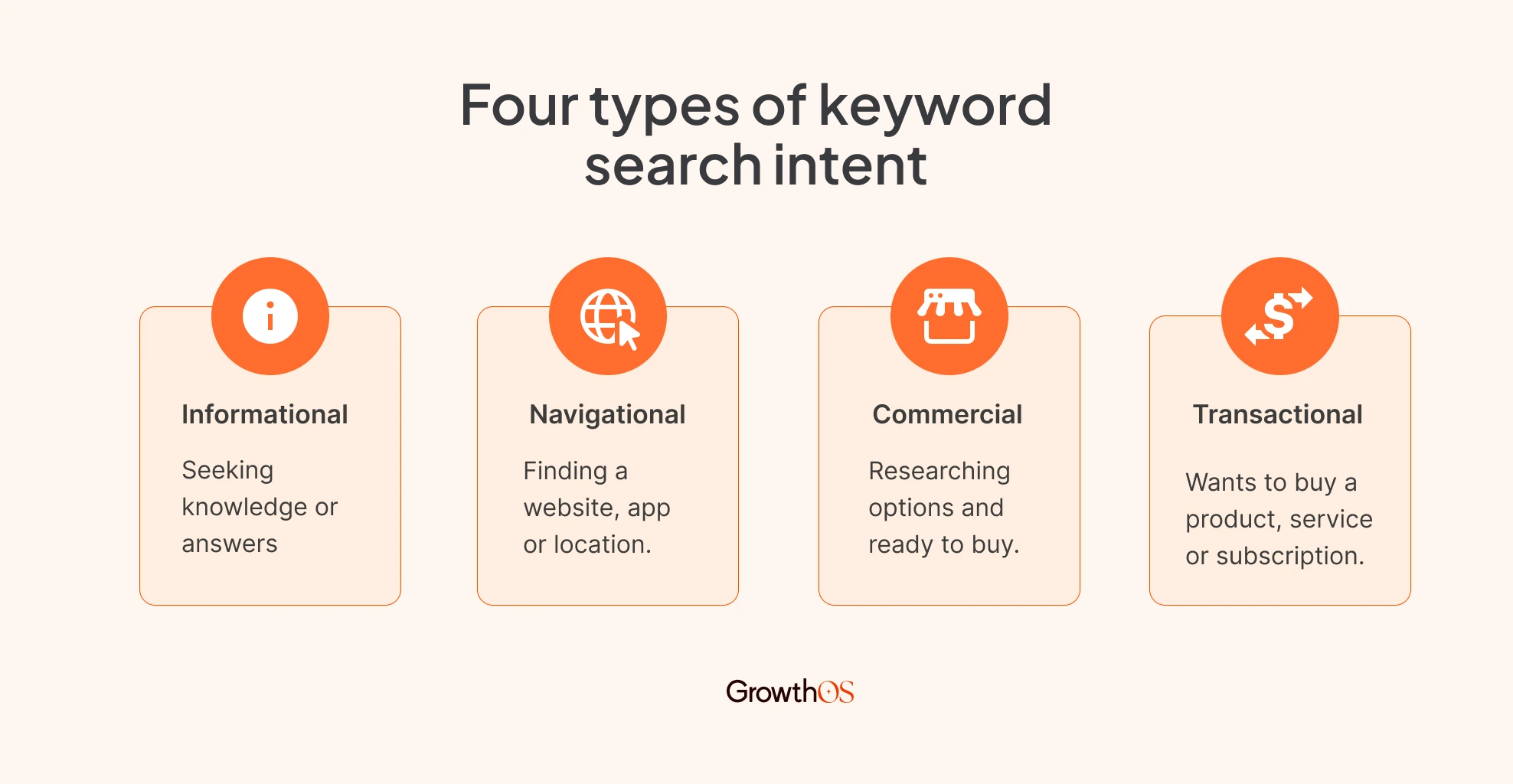
Most SEO failures happen when you mismatch these. For example, trying to rank a pricing page for an informational query usually leads to a poor bounce rate and zero leads.
Use SERPs to Understand What Google and AI Agents Expect
Manual SERP reviews are still the most accurate way to read search intent. For your top keywords, open an incognito tab and analyze the top 10 results.
Here’s what to look for:
- Content format: Are they listicles, product pages, tools, or how-to articles?
- Media type: Do they include video results, PDF downloads, or images?
- SERP features: Are there featured snippets, People Also Ask boxes, or AI Overviews?
Search intent has started to shift from purely keyword matching to user context matching. A recent Exploding Topics study showed a 121% increase in YouTube citations in e-commerce-related queries, suggesting video-first content is becoming more dominant for commercial searches.
If you’re not already showing up in these formats, it’s likely you’re not aligned with what the algorithm expects.
Match Content Type to Intent and Format
Once you understand what Google favors for your query, build your content to match it.
- Informational: Focus on depth, FAQs, and clarity. Use schema markup for better snippet eligibility.
- Commercial: Use structured comparisons, customer quotes, and visual demos.
- Transactional: Keep it simple. Highlight benefits, pricing, and frictionless CTAs.
- Navigational: Create high-authority, branded pages with clear copy and minimal distractions.
Also prepare for zero-click scenarios. If Google answers the query directly in a featured snippet or AI Overview, your job is to still be the source of that answer.
Tip: Use tables, clear H2s, and definition blocks. These formats are easier for AI agents and featured snippets to pull from.
Build for Trust: Why E-E-A-T Still Matters
Even with AI overviews, trustworthiness is non-negotiable. Google’s quality raters and LLMs both assess content based on:
- Experience: Have you used the product or solution?
- Expertise: Are insights attributed to a qualified source?
- Authoritativeness: Is your domain cited by others?
- Trust: Is the content factually accurate, updated, and secure?
Add quotes from subject matter experts. Link to credible external sources. Keep author bios and page timestamps visible.
AI systems like Perplexity, ChatGPT, and Google SGE prefer citing pages that reflect consensus and clarity. That means your page must not only answer a query—it must reflect real-world accuracy and editorial integrity.
Search intent is the glue between your keyword and your content format. Get it right, and you’ll rank across both traditional and AI-driven SERPs. Get it wrong, and you’ll watch traffic bounce without ever converting.
Next, we’ll show you how to assess your competitors and find gaps worth targeting.
Step 4: Evaluate Competition and Opportunities
At this point, you know what your audience searches for and why. The next question is simple. Where can you realistically win?
This is where competitive analysis and keyword gap work come in. The goal is not to copy competitors, but to find openings they have not fully claimed.
1. Benchmark Against Competitors
Start by seeing who already owns the queries you care about.
Use tools like Ahrefs, Semrush, or LowFruits to identify:
- Which pages drive the most organic traffic for your competitors
- Which keywords send that traffic
- Where low authority sites rank on page one (these are “weak spots” worth targeting)
For example, if a competitor’s “SOC 2 checklist” article ranks for 50 related queries but barely mentions automation or pricing, that is a signal. You can create a more specific “SOC 2 automation checklist for SaaS” that covers implementation, tools, and real timelines.
Focus your benchmark on:
- Keywords competitors rank for that you do not
- Topics they cover only at a surface level
- Content formats they are not using (for example, video, tools, calculators)
This gives you a concrete list of opportunities instead of guessing.
2. Identify Weak Spots Like Outdated Or Thin Content
Next, evaluate where competitors are vulnerable. You are looking for queries where:
- The top results are old, thin, or generic
- Multiple low domain authority sites rank on page one
- Forums, Reddit threads, and Quora answers appear beside traditional blogs
Tools like LowFruits highlight these weak spots by flagging low authority domains in the SERP.
For B2B, weaknesses usually show up as:
“2021 guides” that have not been updated for AI search or new regulations
Vendor roundups without clear evaluation criteria
Listicles that ignore real implementation detail or costs
Example: If you see “best customer onboarding tools” with outdated screenshots and no mention of AI workflows, you can win that search with:
- Updated comparisons
- Real pricing bands (for example, “from $49 to $299 per month”)
- Screenshots, workflows, and a short Loom style walkthrough
This is also where entity clarity becomes an advantage. When your brand, product, and core topics are consistently mentioned and structured, AI engines are more likely to select you as a trusted source in overviews and chat responses.
3) Prioritize Based On Business Fit
Not every gap is worth chasing. A strong keyword strategy in 2026 blends competitive opportunity with business value.
For each promising keyword or topic cluster, ask:
- Does this search align with a product, service, or use case you actually sell?
- Is the intent close to revenue, or only good for awareness?
- Can you create something clearly better than what already ranks?
A simple way to score each opportunity:
- Traffic potential: Is there enough volume to matter in your niche?
- Difficulty: Are high authority domains dominating, or is there room for a newer player?
- Business value: Would a conversion from this page be worth $500 or $50,000 to you?
For example: A keyowrd like "what is customer onboarding” would have high traffic, but low buying intent compared to "customer onboarding software for b2b saas"
If your average customer is worth $10,000 per year, a single BOFU keyword that brings in a few qualified deals can easily outperform a high traffic TOFU term in dollar terms.
Score each topic, then prioritize those where:
- You see clear gaps in competitor coverage
- You have a product or service that maps directly to the query
- You can ship a stronger, more up to date asset within your current resources
That final filtered list becomes your real opportunity set. It tells you where to focus your content, link acquisition, and entity building so you are not just “doing SEO,” you are building assets that can drive pipeline.
Next, you will organize these keywords into clusters and maps so they support a coherent content structure, not just isolated blog posts.
Step 5: Organize Keywords Into Clusters And Maps
Keyword lists are useful. Keyword clusters and maps are usable. This is the step where your research turns into a structure that supports topical authority, AI visibility, and a manageable content roadmap.
At a high level, you are doing two things here. Grouping related keywords into topic clusters, and assigning those clusters to specific pages in a keyword map.
1. Group Keywords Into Topic Clusters
Start by grouping keywords that share a theme and intent. Each cluster should represent one problem, use case, or topic you want to be known for.

For a B2B analytics platform, example clusters might be: Marketing attribution models, multi touch attribution, MT attribution for SaaS, BI dashboards, self service analytics, embedded analytics for customers etc.
Within each cluster, define:
- A pillar page that covers the full topic, such as “The Complete Guide To B2B Marketing Attribution”
- Supporting spoke pages that go deeper, such as “Multi Touch Attribution For SaaS Startups” or “Single Touch vs Multi Touch Attribution”
Interlink these pages clearly. Pillar links down to spokes, spokes link back up to the pillar, and related spokes link to each other where relevant. This layout sends strong topical signals to both search engines and AI agents.
2. Create A Keyword Map For Every Key Page
Next, assign keywords to URLs. This helps you avoid cannibalization and makes your content calendar much easier to run.
For each important page, define:
- One primary keyword or cluster focus
- Several secondary keywords that share the same intent
- A few long tail variants that capture more specific questions
Example for a pillar page on “SEO keyword strategy”:
- Primary: “SEO keyword strategy”
- Secondary: “how to build a keyword strategy,” “keyword strategy for B2B,” “keyword strategy framework”
- Long tail: “SEO keyword strategy for SaaS startups,” “keyword strategy for AI search”
Track this in a simple spreadsheet or Notion database with columns like:
- URL
- Page type
- Primary keyword
- Secondary keywords
- Funnel stage
- Status (create, refresh, expand)
This becomes your single source of truth for what each page is responsible for ranking for.
3. Make Clusters AI Friendly
In 2026, you are not just writing for Google. You are also structuring content for AI overviews and LLMs.
For each cluster, plan:
- FAQs that answer direct, snippet friendly questions
- Short, clear definitions at the top of your pillar pages
- Tables, bullet lists, and step by step sections that are easy for models to parse
For example, a cluster on “customer onboarding software” might include:
- A pillar guide with a clear definition in the first 2 to 3 sentences
- An FAQ section answering “What is customer onboarding software” and “How much does customer onboarding software cost”
- A comparison table of tools with pricing bands, such as “$49 to $299 per month”
These structures help you show up in:
- Featured snippets
- AI overviews
- Chat style answers that summarise and cite sources
4. Cluster By Intent, Plan For Multimodal, Use Tools Where It Helps
You can keep this step simple and still be strategic.
Cluster by shared intent
Group keywords that answer the same core question. For example, “best OKR tools,” “OKR software comparison,” and “tools for setting OKRs” all belong on one comparison style page.
Plan for multimodal content
Some clusters deserve more than a blog post. Add planned assets like:
- A YouTube walkthrough for “how to build a reporting dashboard”
- A downloadable checklist for “SEO migration planning”
- A short Loom style demo embedded on BOFU pages
Automate with tools for efficiency
Use tools like Semrush Keyword Strategy Builder, Ahrefs’ Keyword Explorer, or clustering tools such as Keyword Insights or LowFruits to speed up grouping. You do not have to cluster thousands of terms manually. Let the tools suggest groupings, then refine them based on your business context.
Once this step is done, you no longer have a random list of keywords. You have a structured set of topics, mapped to URLs and formats, that supports both human readers and AI systems.
Next, you will turn this structure into live content and start implementing your keyword strategy across pages, on page elements, and distribution channels.
Once your keyword strategy is live, the real work starts. You are no longer guessing, you are testing. The goal here is simple. Keep what works, fix what underperforms, and drop what does not move revenue.
Step 7: Track, Measure, and Refine
Set up a basic measurement loop that you review at least every 6 months.
First, track the core metrics for each priority page:
- Rankings for target keywords
- Organic sessions and assisted conversions
- Leads, demo requests, or revenue influenced
Google Search Console and Google Analytics are your baseline. Layer in a rank tracker like Ahrefs, Semrush, or SE Ranking for position trends over time.
AI agents now account for roughly one third of organic search activity, so your tracking needs to go beyond classic rankings. Where possible, monitor:
- Mentions and citations in tools like Perplexity or ChatGPT
- Appearance in Google AI Overviews or rich results
- Branded search growth and direct traffic trends
You do not need perfect attribution, but you do need directional signal.
Use a simple review checklist every 6 months:
Track AI Visibility
Check which pages are gaining snippets, overviews, or being referenced by AI tools. Strengthen those with fresher data, clearer structure, and stronger internal links.
Adjust For Algorithm Changes
When you see drops across a set of pages that share the same intent or format, revisit search intent and SERPs. Update content types, add missing sections, or consolidate thin pages that compete with each other.
Measure ROI Against Goals
Compare outcomes to the S.M.A.R.T. goals you set earlier. For example, if you invested $5,000 in content and link building for a cluster that brought in $30,000 in closed deals over 12 months, that cluster has a 500 percent ROI. Prioritize more content around that theme and similar intent.
Over time, this feedback loop turns your keyword strategy into a living system. Instead of rewriting everything each year, you iterate on proven winners, retire losing bets, and keep your SEO aligned with both search behavior and revenue.
Final Thoughts
A strong keyword strategy in 2026 is not about chasing volume. It is about understanding intent, structuring topics into clusters, and making your content usable by both search engines and AI agents. When you combine that with consistent measurement and sensible iteration, SEO becomes a reliable growth channel for B2B, not a vanity metric.
You do not need a hundred pages to get started. Begin with a few high intent topics, map them properly, ship focused content, and refine based on what actually drives qualified leads and revenue. Simple, clear, and aligned with your expertise.

Taher Batterywala
Organic Growth Lead
Taher Batterywala is an SEO and Growth Content Marketer. With over 8 years of B2B marketing experience and a diversified skill set, he helps craft winning strategies and execute end-to-end campaigns for B2B and SaaS companies to achieve scalable organic growth. Outside of work, he enjoys watching movies, photography, and dabbling in design. You can find him on LinkedIn and X.

More insights
Get Growth Insights Delivered to Your Inbox
Join B2B marketers getting weekly strategy breakdowns on SEO, AI search, PPC, and YouTube—straight talk, no generic advice.
Oops! Something went wrong while submitting the form.




.svg)