
We'll discuss your goals, current challenges, and how our process can help to drive real business growth.
SEO
What Google's March 2026 Spam Update Means For Your SEO
Taher Batterywala
March 26, 2026
5 min
TABLE OF CONTENTS
Google’s March 2026 spam update launched on March 24, 2026, and finished rolling out in under 20 hours, making it the fastest confirmed spam update in dashboard history. It targets sites violating Google’s existing spam policies globally, across all languages. It does not target link spam or site reputation abuse specifically. If your organic traffic dropped in the last couple of days, this update could be why.
Key Highlights of the Google March 2026 Spam Update
The update was released on March 24, 2026, at 12:18 PM PDT and completed by March 25 at 7:30 AM PT. The total rollout lasted under 20 hours. For comparison, the December 2024 spam update took 7 days, and the August 2025 spam update took 27 days to complete.
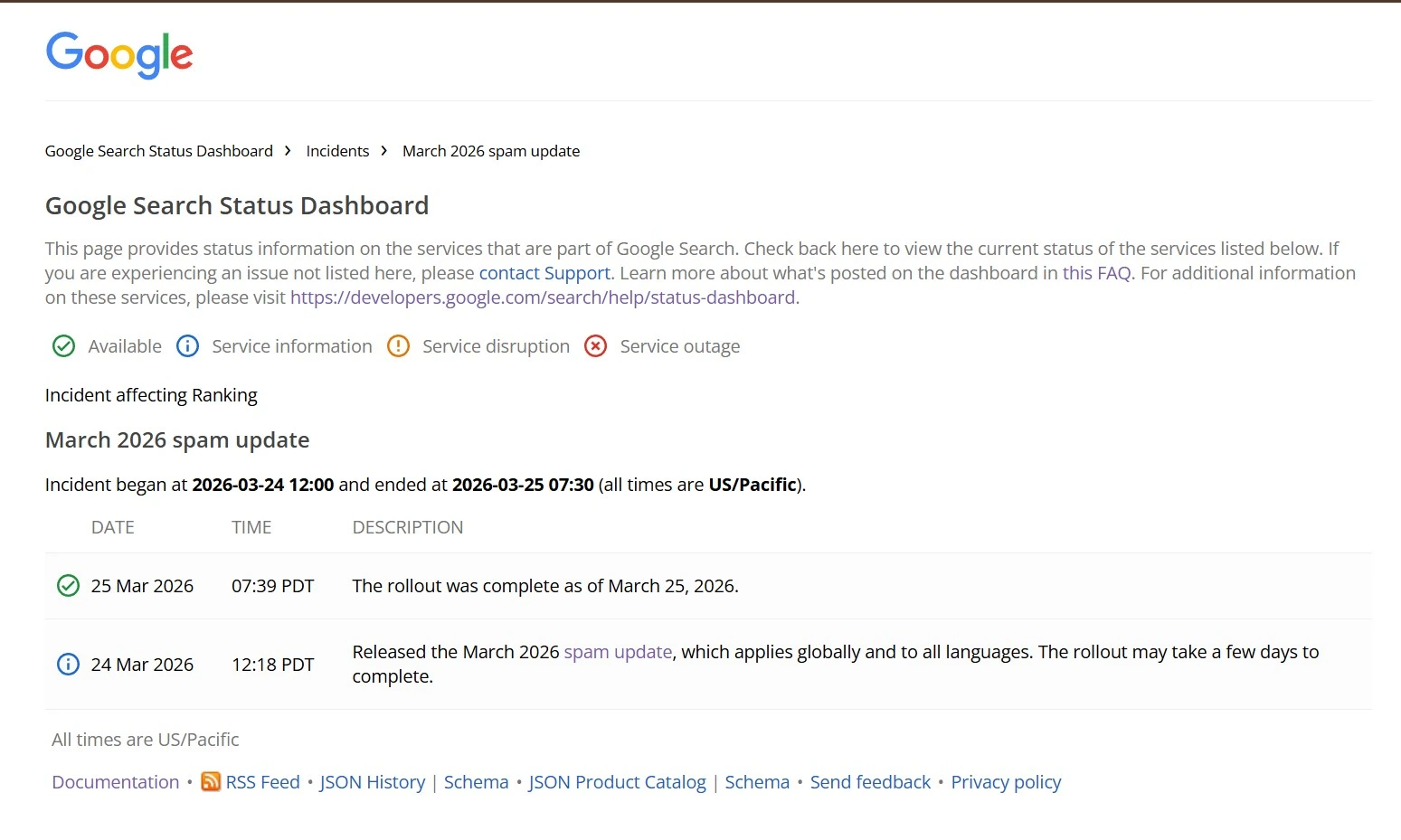
The update applies globally to all regions and languages. It is powered by SpamBrain, Google’s AI-based spam prevention system, which gets periodic improvements to detect new forms of search manipulation.
According to Barry Schwartz at Search Engine Roundtable, this update does not target link spam, does not target the site reputation abuse policy, and excludes some other specific policies. Google also did not announce any new spam policy categories with this update, unlike the March 2024 spam update, which introduced scaled content abuse, expired domain abuse, and site reputation abuse as entirely new policy categories.
It is also worth noting the timing. This is the second algorithm update Google has announced in 2026, arriving just three weeks after the February Discover update finished rolling out, and while the March 2026 Broad Core Update (launched March 10) was still in progress. That overlap makes it harder to isolate which update is responsible for any ranking changes you may have noticed.
What is a Google Spam Update and How it Differs from a Core Update?
A Google spam update is a targeted enforcement action. It improves Google's automated spam detection systems (primarily SpamBrain) to better catch sites that violate Google's published spam policies. The result for violating sites is lower rankings or complete removal from search results.
Google's spam policies cover a specific set of violations. For example, these include:
- Cloaking: showing different content to Google than to users
- Doorway pages: pages built purely to rank with no real user value
- Hidden text and links: embedding content invisible to users but visible to crawlers
- Auto-generated spam content: mass-produced pages with no original value
- Scraped content: copying content from other sites without adding anything useful
- Link schemes: buying, selling, or exchanging links to manipulate rankings
- Sneaky redirects: sending users to a different page than what Google crawled
- Bulk content abuse: flooding a site with low-quality pages at scale, often using AI
Since March 2024, the policies also cover site reputation abuse (sometimes called parasite SEO) and expired domain abuse.
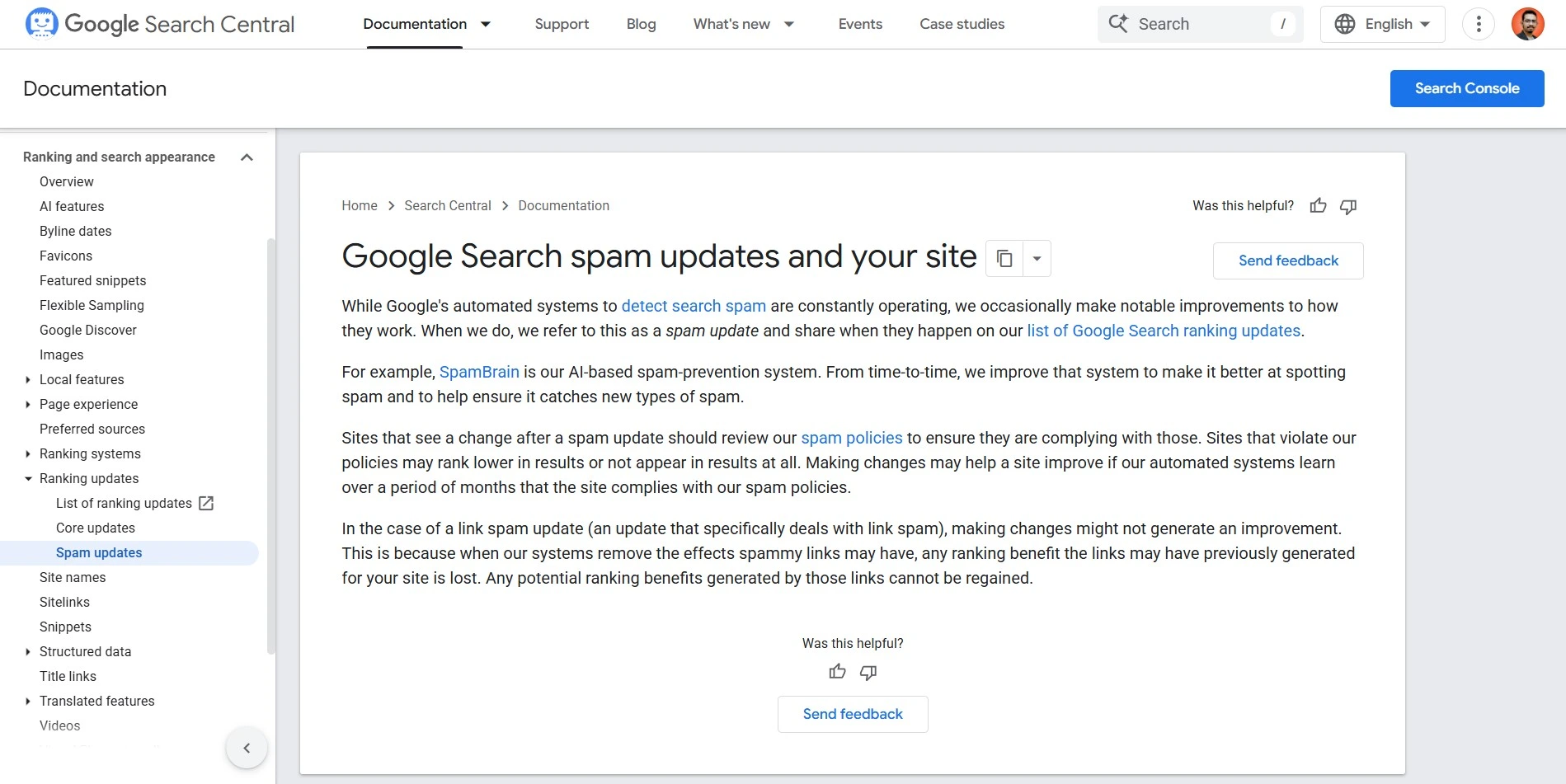
This is fundamentally different from a core update. A core update re-evaluates how Google assesses content quality and relevance across the board. Your site can drop in a core update without breaking any rules, simply because the algorithm now values a different quality signal more heavily, or because competitors improved. A spam update, on the other hand, penalizes your site because it is breaking a specific, documented rule.
One more thing to keep in mind: Google ran both a core update and this spam update simultaneously in March 2026. If your traffic dropped between March 10 and March 27, the cause could be either update, or both. The way to isolate spam update impact specifically is to check your Google Search Console data during the window of the rollout.
What to Do If the Google March 2026 Spam Update Affected Your Rankings
If you noticed a drop in your rankings or a decline in organic traffic around March 24–25, here is a step-by-step approach to diagnose and respond.
Step 1: Confirm It Is Actually the Spam Update
Start by checking Google Search Console for any manual actions. Then compare your traffic drop dates against the March 24–25 rollout window. If the decline started earlier (around March 10, when the core update began), the core update is the more likely cause. Also rule out unrelated factors like site migrations, seasonal patterns, or technical issues.
Step 2: Audit Your Site Against Google’s Spam Policies
Google’s spam policies documentation is publicly available and surprisingly specific. Go through each policy area: cloaking, doorway pages, hidden text, auto-generated content, scraped content, sneaky redirects, and link schemes. Pay close attention to scaled content abuse (mass-produced AI content with no original value) if you have been publishing at high volume. If your site has forums, open comment sections, or guest posts, check for user-generated spam as well.
Step 3: Fix the Violations, Then Wait
Remove or substantially improve any content that violates Google’s policies. Cosmetic tweaks will not work. According to Google’s official spam updates documentation, making changes may help a site improve if Google’s automated systems learn over a period of months that the site complies with their spam policies.
Recovery is not instant. Google has confirmed it will do periodic refreshes of the spam update, so compliance improvements will be picked up over time.
There is one critical distinction to understand here. For content-related spam violations (thin content, cloaking, doorway pages), recovery is possible with genuine fixes and patience. But for link spam violations, the situation is categorically different.
Google’s documentation states explicitly: once the ranking benefits of spammy links are neutralized, those benefits cannot be regained. Even though this particular update did not target link spam, this is a principle worth internalizing for any SEO strategy going forward.
What This Means for SEO Going Forward
The pace of Google’s spam enforcement is accelerating. 2024 had three spam updates. 2025 had one (but it ran for 27 days). 2026 already has one in March, and it rolled out in record time. SpamBrain is getting faster, not softer.
At the same time, Google’s stance on AI content continues to sharpen. An April 2025 update to the quality rater guidelines introduced AI content evaluation criteria, directing human evaluators to flag pages with main content generated by AI tools that lack genuine value. The line is clear: AI-assisted content that serves users is fine. AI-generated content at scale with no editorial oversight is a spam policy violation.
The sites that consistently win through these updates are the ones that never have to worry about them. Original, expert-led content. Natural link profiles. No shortcuts with parasite SEO or expired domain plays. For these sites, every spam update is an opportunity, not a threat, because weaker competitors get pushed down or deindexed entirely.
How GrowthOS can Help
Staying compatible with Google’s evolving spam policies is not a one-time audit. It is an ongoing practice that requires consistent SEO execution, from content strategy to technical hygiene to link profile management.
That is exactly what we do at GrowthOS. We don’t just advise on SEO. We operate it. If you are looking for a team that builds and runs your organic growth engine so you stay ahead of every core and spam update Google rolls out, let’s talk.

Taher Batterywala
Organic Growth Lead
Taher Batterywala is an SEO and Growth Content Marketer. With over 8 years of B2B marketing experience and a diversified skill set, he helps craft winning strategies and execute end-to-end campaigns for B2B and SaaS companies to achieve scalable organic growth. Outside of work, he enjoys watching movies, photography, and dabbling in design. You can find him on LinkedIn and X.

More insights
Get Growth Insights Delivered to Your Inbox
Join B2B marketers getting weekly strategy breakdowns on SEO, AI search, PPC, and YouTube—straight talk, no generic advice.
Oops! Something went wrong while submitting the form.




.svg)