
We'll discuss your goals, current challenges, and how our process can help to drive real business growth.
Content Marketing
How SEO And Content Marketing Together Drive Organic Growth
Taher Batterywala
May 1, 2026
10 min
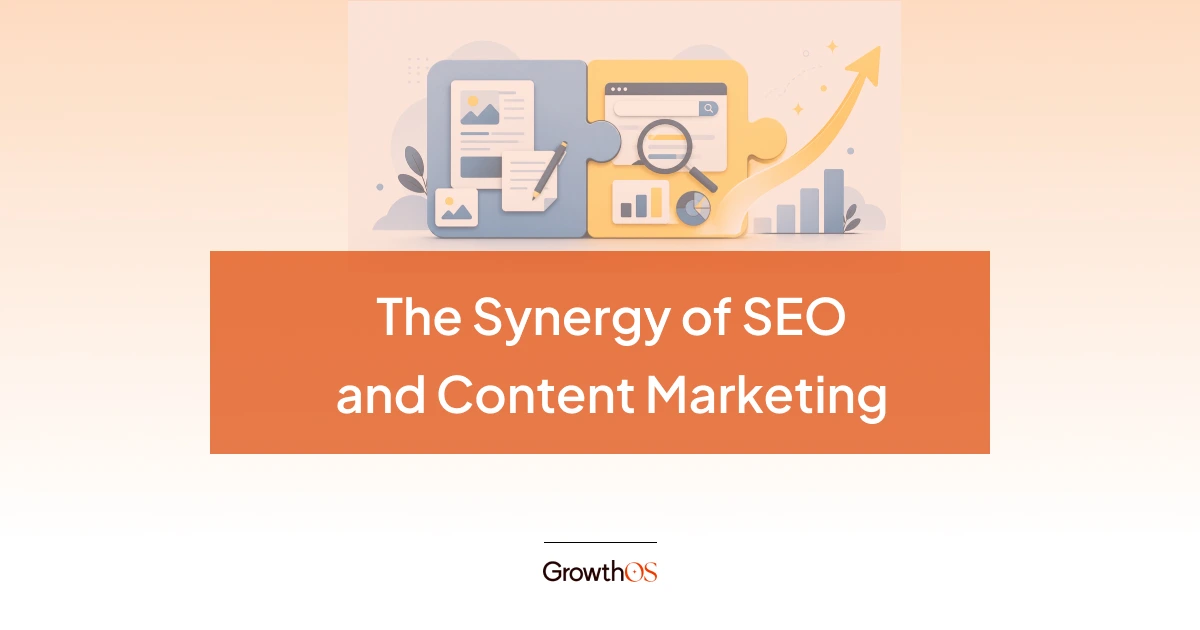
TABLE OF CONTENTS
For years, SEO and content marketing lived in different corners of the marketing team. SEO owned rankings. Content owned the editorial calendar. The two rarely overlapped. That separation no longer works.
In 2026, B2B buyers research vendors across Google, AI Overviews, LinkedIn, Reddit, ChatGPT, and Perplexity before they speak to anyone in sales. Discovery is fragmented. Attention is scarce. The brands winning organic growth treat SEO and content as one connected system, not two parallel tracks.
This article breaks down what each discipline does, where they differ, how they reinforce each other, and what a working strategy looks like. If you're a B2B marketer trying to make organic a reliable growth channel, this is where to start.
TL;DR
SEO and content marketing work best as one connected system: SEO reveals demand, while content turns that demand into assets that build trust, rankings, citations, and pipeline.
SEO shapes content strategy by showing what buyers search for, which questions matter, and which topics map to each funnel stage.
Content marketing makes SEO work by turning keywords into useful guides, comparisons, case studies, and landing pages that people and AI can trust.
SEO and content are different disciplines, but they share one organic growth lane, where search intent, internal links, topical authority, and conversion paths overlap.
Prioritize assisted conversions, branded search growth, AI citations, and CRM-influenced revenue, not traffic alone.
Avoid treating SEO as a checklist, publishing without purpose, chasing broad keywords, ignoring technical SEO, or measuring success only by pageviews.
SEO And Content Marketing Are No Longer Separate Growth Channels
The old division made sense when search was simpler. You picked keywords, published pages, built links, and tracked rankings. Content was something you did separately to educate prospects and fill the blog.
That model is broken now. A B2B buyer researching enterprise software doesn't follow a straight path from one keyword to one blog post to a demo request. They read articles, compare solutions, ask AI tools for vendor shortlists, scan Reddit threads, and revisit your pricing page multiple times before converting.
SEO without content has nothing meaningful to rank, cite, or convert. Content without SEO often becomes invisible, scattered, or dependent on paid distribution to reach anyone. Organic growth happens when both work as one connected system.
What SEO And Content Marketing Actually Mean
Before getting into how they work together, it helps to be clear on what each one does. This is where many teams get the relationship wrong.
What SEO Does
SEO is the process of making your website discoverable, understandable, and useful across organic search. It includes keyword research, search intent mapping, site architecture, technical health, internal linking, content optimization, and authority-building.
In 2026, SEO also means preparing content for AI-led discovery, not just blue-link rankings. Google's AI Overviews, featured snippets, and People Also Ask now shape how buyers find information before they ever visit a website.
SEO is not just for blog posts. It affects product pages, landing pages, comparison pages, case studies, and documentation. In short: SEO identifies what your buyers are searching for and makes sure your content shows up when they look.
What Content Marketing Does
Content marketing is the process of creating and distributing useful content to attract, educate, and convert the right audience.
It includes blogs, guides, case studies, thought leadership articles, landing pages, newsletters, and sales enablement assets. In B2B, content marketing plays a long game. It answers buyer questions before a prospect ever talks to sales. It builds trust, demonstrates expertise, and gives buyers a reason to remember your brand.
But content without a strategy is just publishing. And publishing without SEO is hoping the right audience finds you by accident.
The Difference Between SEO And Content Marketing
They're different disciplines, but not competing ones. Think of them as two functions with different jobs that depend on each other to work.
SEO focuses on discoverability. It handles search demand, keyword mapping, technical access, site structure, crawlability, and performance tracking. SEO answers: can buyers find you, and does Google understand what you offer?
Content marketing focuses on trust and influence. It handles audience education, narrative, thought leadership, use cases, proof, and conversion support. Content answers: once buyers find you, do they believe you?
Here's a quick comparison:
The overlap is where growth happens. Search intent, topic clusters, internal linking, content quality, and conversion journeys all sit in the space both disciplines share. That shared space is exactly where your organic strategy should live.
How SEO And Content Marketing Work Together
Most teams understand that integration matters. But they treat it as adding keywords to a blog post or sending the content team an SEO checklist after the draft is already written. That's not integration. That's retrofitting. Here's what a real working relationship looks like.
SEO Tells You What Your Audience Is Searching For
Keyword research reveals demand. But it should inform content, not dictate it blindly.
Search data helps identify topics, pain points, buying questions, objections, and comparison intent across every stage of the funnel. A B2B SaaS company targeting project management shouldn't only go after "project management software." It should also cover:
- "How to manage agency projects"
- "Client approval workflow tools"
- "Asana alternatives for agencies"
- "Agency capacity planning"
- "Project profitability tracking"
Each of those queries signals a different buyer, a different problem, and a different funnel stage. SEO maps that demand so content can serve it. Teams that want to build this foundation can start with a highly thoughtful SEO strategy that connects search demand to revenue priorities.
Content Turns Search Intent Into Useful Assets
SEO identifies the query. Content shapes the answer. And not every query becomes a blog post.
Some questions need a detailed guide. Some need a comparison page. Some need a template, a case study, or a product-led landing page with a clear call to action. Matching the content format to the buyer's intent is where teams consistently underdeliver.
A buyer searching "Zendesk alternatives" is not looking for a definition. They're evaluating options. Give them a comparison page with real differences, pricing context, and use cases — that's what earns both rankings and conversions.
SEO Gives Content A Structure Search Engines And AI Can Read
Well-structured content performs better for both traditional search and AI-powered discovery. Practically, that means:
- Clear H1, H2, and H3 headings that reflect the topic and intent
- Internal links that connect related pages across the site
- Schema markup for articles, FAQs, and product pages
- Author and reviewer information that signals real expertise
- Concise answer blocks that AI tools can extract and cite
- Entity-rich language that helps search engines understand context
This isn't about gaming algorithms. It's about making useful content easier to find, parse, and trust.
Content Builds Authority That SEO Compounds Over Time
Search engines and AI systems favor brands with a consistent, coherent body of content on a subject. This is topical authority, and it's built through depth, not volume.
A cluster of content covering a topic from multiple angles, including definitions, use cases, comparisons, case studies, templates, and thought leadership, creates more authority than 50 disconnected blog posts. Internal links between those assets reinforce relevance. External sites and AI tools are more likely to cite you when you're clearly the best source on a subject.
Publishing more is not the strategy. Publishing with coherence and intent is. A structured content marketing program helps turn scattered ideas into assets that support search visibility, buyer education, and pipeline.
Why This Matters Even More In 2026
The case for integrating SEO and content marketing has always been strong. In 2026, it's urgent.
AI Overviews And Zero-Click Search Are Changing How Visibility Works
Google's AI Overviews now summarize results for a wide range of queries. Users can get answers without clicking through to any website. Pew Research found that users who saw an AI summary clicked traditional results in only 8% of visits, compared with 15% when no AI summary appeared.
That doesn't make SEO irrelevant. It changes what visibility means. Brands now need to earn both clicks and citations. Being the source that AI Overviews pull from is a new form of ranking, and it favors brands with clear, well-structured, trustworthy content.
Semrush reported US zero-click search reached roughly 27.2% of search traffic in 2025, up from 24.4% in March 2024. The solution is not to panic. It's to create content worth citing.
LLMs Are Now Part of B2B Discovery Process
Buyers use ChatGPT, Perplexity, Gemini, and Claude to research vendors, compare products, and generate shortlists. These tools don't behave like Google. They retrieve, summarize, and synthesize information from across the web and surface brands that are consistent, credible, and well-covered.
DataReportal's Digital 2026 report found more than 1 billion people now use AI tools every month. For B2B brands, that's a growing layer of discovery that doesn't show up in Google Search Console.
To earn visibility in LLM-generated answers, content needs to be factually accurate, clearly structured, and coherent across your entire site. Vague, generic content gets ignored by both humans and machines.
Machine Crawlers Are Reading Your Content Too
Content is no longer consumed only by human readers and Googlebot. AI crawlers are now a significant part of the traffic environment. Cloudflare reported GPTBot grew 305% from May 2024 to May 2025, while Googlebot grew 96% over the same period.
The goal isn't to "optimize for LLMs" as a separate tactic. The goal is to make useful content easier to find, parse, and trust — which benefits every crawler and every human reader.
One important note: Google's Q1 2026 earnings remarks confirmed search queries are at an all-time high, with AI features driving more usage, not less. Traditional search is not dead. It's changing shape. Your strategy needs to account for both.
The Organic Growth Flywheel: Four Steps To Make SEO And Content Compound
When SEO and content marketing work together consistently, they create a compounding loop. Each cycle produces more authority, better rankings, stronger buyer trust, and more useful content decisions. Here's the model we use at GrowthOS.
Step 1: Identify Search Demand And Business Priorities
Start with business goals, not keyword volume. Ask which products or services need more organic demand, which customer segments matter most, and where search-driven traffic can realistically influence pipeline.
Say you're a B2B SaaS company selling HR software to mid-market companies.
The goal isn't to rank for every HR-adjacent keyword. It's to rank for terms that your ideal buyers actually search, like "onboarding software for scaling teams," "HR tool for 200-person company," or "BambooHR alternative for mid-market."
These queries have lower volume than broad terms, but they attract buyers with a real problem and a budget. Build your keyword and topic map around that intent, then align content priorities to the products and segments driving the most revenue.
Step 2: Build Topic Clusters Around Buyer Problems
A topic cluster is a group of content assets that covers one subject from multiple angles, all connected through internal links. It's how you build topical authority without publishing in isolation.
Take a SaaS company selling customer support software. A well-built cluster might include a pillar guide on "customer support automation," supported by posts on "how to reduce support ticket volume," "AI chatbot vs. live agent," and "help desk software comparison," all internally linked to the product and feature pages.
Each piece serves a different buyer at a different stage. The TOFU guide attracts buyers early in research. The comparison page catches buyers evaluating options. The feature page closes the loop. Without internal links connecting them, each asset works alone. With them, the whole cluster compounds.
Step 3: Create Content That Earns Trust And Citations
Useful content is not enough in 2026. Content needs to be worth citing, by other writers, by journalists, and by AI systems summarizing answers for buyers.
That means going beyond what already exists on the SERP. A SaaS company writing about "project management for agencies" shouldn't recycle the same five tips every competitor covers.
It should add something original: proprietary data from customer interviews, a framework built from real client work, a specific example of how an agency reduced project overruns by restructuring their approval workflow, or an honest trade-off analysis that most content skips.
This is what builds E-E-A-T in practice. Google's helpful content guidance rewards content that shows real experience and genuine expertise. So do the LLMs deciding which sources to surface in AI-generated answers.
Step 4: Measure What Actually Moves The Business
Pageviews tell you what got read. They don't tell you what drove revenue. B2B content teams that report only on traffic are optimizing for the wrong outcome.
The metrics that matter are the ones connected to pipeline. Track assisted conversions, meaning organic sessions that contributed to a demo request or trial signup even if it wasn't the last touch.
Track branded search volume over time, which signals whether your content is building recognition. Monitor which content pieces appear in AI Overviews or get cited in LLM-generated answers.
And connect organic data to your CRM so you can see which SQLs and closed deals had organic content in their journey. A blog post that drives 400 visits and zero pipeline is less valuable than one that drives 60 visits and four qualified demo requests.
Common Mistakes That Keep SEO And Content Marketing From Working Together
Most teams know integration matters. But a few persistent habits consistently get in the way.
Treating SEO as a checklist
When you perform SEO checks after the article is written, it's justcosmetic. You're adjusting headings and stuffing keywords into a draft that was built without any search intent in mind.
The result is content that doesn't match what buyers actually search for, doesn't fit naturally into your site structure, and misses internal linking opportunities that were obvious from the start. Fix it before writing begins, not after.
Publishing without purpose
Every piece of content consumes budget, time, and editorial bandwidth.
When there's no defined intent behind it, whether that's capturing a search query, educating a buyer segment, or supporting a product page, it adds to your content library without adding to your pipeline.
Over time, this creates bloat: hundreds of posts with thin traffic, no rankings, and no conversion paths leading anywhere useful.
Chasing high-volume keywords
A SaaS company ranking for "what is project management" will pull a lot of traffic from students, academics, and professionals who will never buy.
The cost is real: you spend months building content for an audience with no purchase intent, while the buyers actively comparing your product against competitors find nothing useful on your site. High-volume keywords can look good in reports and deliver nothing in revenue.
Ignoring technical SEO
You can produce well-researched, expertly written content and still see it perform poorly if the technical foundation is broken. Pages that load slowly, have duplicate content issues, are blocked from crawling, or sit in dead-end silos with no internal links are harder for search engines to find and rank.
Technical SEO isn't appealing as writing or designing new stuff daily, but it's the infrastructure everything else depends on.
Creating generic content
When your content only restates what every competitor has already published, there's no reason for a reader or an AI system to choose you as the source.
Google's helpful content guidance is explicit: content written primarily to match search patterns, rather than to genuinely help a reader, performs poorly over time.
The consequence is a growing library of content that doesn't rank on SERPs or in AI Overviews, earns no citations, and builds no authority.
Measuring content only by traffic
Traffic is a leading indicator, not an outcome.
A post driving 5,000 monthly visits from broad informational queries may contribute nothing to your pipeline.
Meanwhile, a post driving 200 visits from buyers searching "enterprise HR software for 500 employees" may be closing deals. When you optimize purely for sessions, you end up creating content that performs well in dashboards and poorly in revenue conversations.
How GrowthOS Connects SEO And Content Marketing
At GrowthOS, we don't treat content as a publishing calendar or SEO as a monthly technical report. We build one system.
The process starts with business priorities: which segments matter, which products need demand, and where organic can influence pipeline. Our SEO Strategy service maps search demand to business goals, identifies content gaps, and creates a clear plan for what to build, update, and consolidate.
From there, our Content Marketing service takes that strategy into production: briefs, writing, design, distribution, and refresh cycles that keep content performing over time.
The result is an organic growth system where SEO informs content, content builds authority, and authority compounds into pipeline.
Creating a Scalable Organic Growth System
SEO and content marketing are stronger together. SEO without content has nothing to rank. Content without SEO rarely gets found. When they share the same strategy, the same priorities, and the same definition of success, organic growth becomes a compounding asset — not a line item with uncertain returns.
The brands that will own organic visibility in 2026 are the ones building systems, not just publishing posts.
If your content is getting published but not compounding, it's worth looking closely at how your SEO and content strategy connect. Book a discovery call to discuss your content marketing goals and how GrowthOS can help you build an organic growth system that works.

Taher Batterywala
Organic Growth Lead
Taher Batterywala is an SEO and Growth Content Marketer. With over 8 years of B2B marketing experience and a diversified skill set, he helps craft winning strategies and execute end-to-end campaigns for B2B and SaaS companies to achieve scalable organic growth. Outside of work, he enjoys watching movies, photography, and dabbling in design. You can find him on LinkedIn and X.

More insights
Get Growth Insights Delivered to Your Inbox
Join B2B marketers getting weekly strategy breakdowns on SEO, AI search, PPC, and YouTube—straight talk, no generic advice.
Oops! Something went wrong while submitting the form.




.svg)