
We'll discuss your goals, current challenges, and how our process can help to drive real business growth.
YouTube
Why YouTube SEO is Important for Channel Growth
Pritesh Jagtap
April 27, 2026
5 min
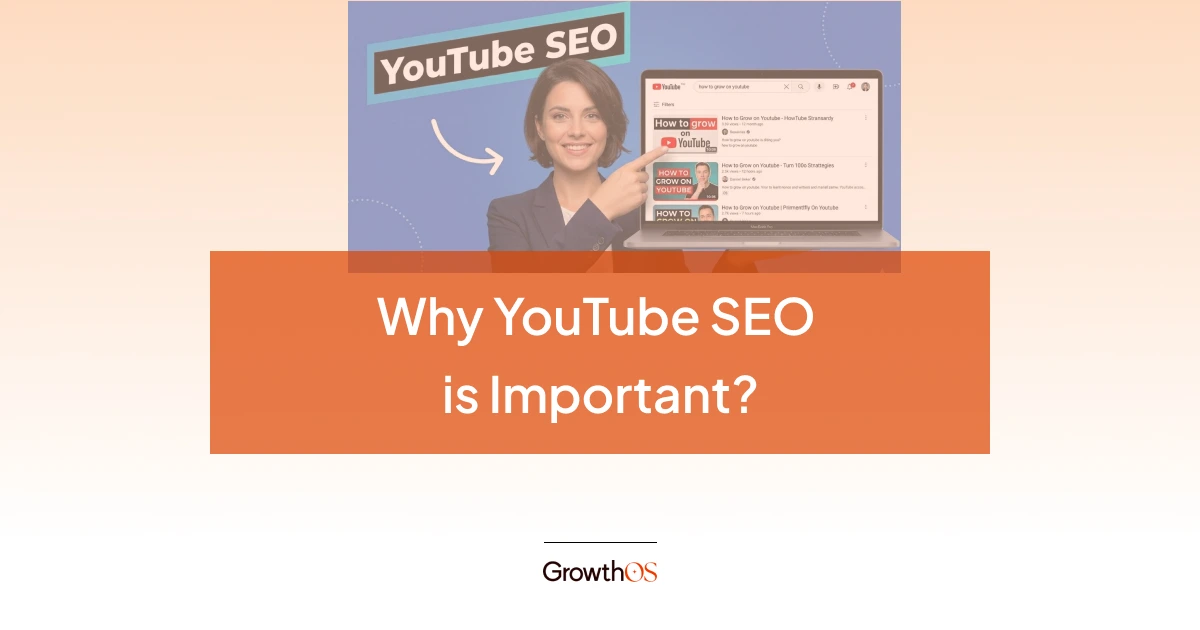
TABLE OF CONTENTS
One of the most common questions we get during discovery calls whether SEO is important for YouTube. So, the answer is yes, but its role is narrower and more strategic than most guides suggest.
YouTube SEO controls discoverability: how your videos show up in YouTube search, Google search, and increasingly, AI-generated answers. It does not control the broader recommendation engine that drives the majority of YouTube views.
Every listicle you’d read on the internet frames SEO as the silver bullet for channel growth. But in our experience of managing 15+ channels, we can claim that framing is misleading.
In this article, we explain what YouTube SEO actually affects, when it moves the needle, when it doesn’t, and what has changed in 2026 that makes this question worth revisiting.
Whether you’re a creator, a content marketer, or a B2B brand using YouTube as a growth channel, this is the honest version.
TL;DR
YouTube SEO is important because it controls the high-intent, search-driven slice of discovery, helping videos compound organic traffic on YouTube, Google, and AI Overviews for years
SEO for YouTube vidoes drives the strongest results for evergreen, searchable content like tutorials, how-tos, B2B explainers, product comparisons, and educational videos.
For content types like vlogs, comedy, lifestyle content, Shorts, or trend-chasing videos, SEO doesn't bring much impact. These formats win on hooks, not keywords.
Tags are no longer a real ranking factor. YouTube has officially confirmed they play a minimal role in modern video discovery.
Keyword stuffing doesn't lift rankings, longer descriptions don't outperform the more short/creative ones, and chasing high-volume keywords loses to dominating well-chosen niche ones.
What Does YouTube SEO Actually Mean?
YouTube SEO is the practice of optimizing video titles, descriptions, tags, thumbnails, captions, and channel signals so your videos rank in YouTube search, appear in Google’s video results, and surface in AI-generated answers.
Simple definition, but this is an important part: YouTube SEO is not the same thing as the YouTube algorithm. The algorithm decides what to recommend on the Home feed, the Up Next rail, and the Shorts feed. SEO decides what shows up when someone types a query.
The difference matters because roughly 70% of YouTube watch time comes from algorithmic recommendations, not from search. Creators who confuse the two burn hours optimizing tags when their real problem is a weak hook or poor retention.
Why Is YouTube SEO Important in 2026?
If SEO only influences part of YouTube discovery, why does it still matter? Because the slice it controls is the highest-intent, most compounding traffic on the platform. Here are the four reasons that hold up under pressure.
1. SEO captures high-intent viewers that recommendations can’t reach
Recommendation feeds serve videos to passive browsers. Search serves videos to people actively looking for an answer. Search traffic converts at a dramatically higher rate for educational, B2B, and tutorial content, which is exactly the content most business channels produce.
A viewer searching “how to run a sprint retrospective” is closer to buying project management software than a viewer scrolling the Home feed. That is the difference between impressions and intent.
2. YouTube videos now rank in three places, not one
Videos are increasingly showing up in Google AI overviews, organic results and yes, the obvious one - YouTube search.
Google SERP video carousels. YouTube videos routinely hold the Videos carousel and the top organic slot for how-to queries.
AI Overviews and AI search engines. Google’s AI Overviews, ChatGPT, and Perplexity now cite YouTube videos as sources. YouTube’s 2025 move to satisfaction-weighted discovery and its deeper AI analysis of transcripts and chapters mean your video text directly influences whether you get pulled into an AI answer.
3. SEO gives compounding results, unlike ads
Paid views stop the day the budget stops. An SEO-optimized video keeps ranking for years. A single evergreen tutorial built around a stable search query can accumulate views indefinitely at a cost-per-view that trends toward $0. This is why YouTube SEO is a core strategic investment for B2B and service businesses with long sales cycles. The math only works if the asset keeps earning.
4. It levels the playing field for smaller channels
The recommendation algorithm favors channels with established watch-time history. Search is more democratic. A well-optimized video from a 500-subscriber channel can outrank a million-subscriber channel on a specific, well-chosen query. This is the most overlooked reason SEO matters. For a new channel, search is the one growth lever you actually control.
When Does YouTube SEO Not Matter (Much)?
Contrarian to the public opinion, YouTube SEO is not universally important. These are following cases where it
Pure entertainment channels
Vlogs, comedy, and lifestyle content get watched, not searched. Time is better spent on thumbnails, hooks, and retention.
YouTube Shorts
Shorts discovery is almost entirely feed-driven. Keywords in titles help at the margins, but hook quality and completion rate are what actually rank a Short.
Trend-chasing content
Reacting to breaking news or viral moments is a race against time. SEO won’t rank the video before the trend dies.
Channels with a retention problem
If viewers drop off in the first 30 seconds, no amount of keyword optimization fixes that. Fix the video first, then optimize.
YouTube SEO matters most when you’re creating searchable, evergreen content and want to compound organic visibility over time. If that’s you, here’s where to actually put your effort.
What Should You Actually Optimize?
The table below is based on what YouTube’s own algorithm team has confirmed matters:
If you do the actions mentioned in the left columns consistently and you’ll capture roughly 80% of the available SEO upside. The rest is diminishing returns.
⚠️ Important: YouTube SEO works best when it’s integrated with your broader content SEO strategy. The same keyword research should inform your blog posts, landing pages, and videos together. Siloed optimization is why most YouTube programs plateau.
Busting Common YouTube SEO Myths
If you’ve read three YouTube SEO articles, you’ve read the same five tips. Some of those tips are outdated. Here’s what most guides still get wrong in 2026:
Tags are no longer a meaningful ranking factor. YouTube’s official position is that tags play a minimal role in video discovery, yet most listicles still lead with them.
Keyword density is irrelevant. YouTube ranks on watch time and viewer satisfaction, not how many times “how to bake bread” appears in the description.
More metadata isn’t better. A 2,000-word description stuffed with keywords will not outperform a sharp 150-word one that matches search intent.
Chasing high-volume keywords is a trap. Ranking #1 for a low-competition keyword you can dominate beats ranking on a 20th position for a keyword you can’t.
SEO is not a substitute for a good video. Optimization amplifies quality; it does not create it. With YouTube’s 2026 move toward satisfaction-weighted ranking, a well-optimized bad video now gets penalized faster than ever.
Final Thoughts
YouTube SEO is important because it controls the search-driven, high-intent, compounding slice of YouTube discovery. That slice is exactly where brands, educators, and small-to-midsize creators have the most to gain. It’s not a silver bullet, and it’s not the right priority for every kind of channel. But for anyone serious about building durable organic traffic on YouTube, SEO is a core discipline, not a checklist.
If you’re treating YouTube as a growth channel and want a strategy that connects search intent, video, and your broader content engine, that’s exactly what our team does every day. Book a discovery call with GrowthOS and we’ll walk you through how to build a YouTube SEO program that actually compounds.

Pritesh Jagtap
Founder
Pritesh Jagtap is the founder of GrowthOS, where he helps startups and creators scale through growth systems, content, and SEO/ GEO strategies. With a background spanning growth, marketing, and operations, he’s passionate about building frameworks that drive sustainable results. Beyond GrowthOS, he experiments with creative projects, explores moutains trails and be around offline communities.

More insights
Get Growth Insights Delivered to Your Inbox
Join B2B marketers getting weekly strategy breakdowns on SEO, AI search, PPC, and YouTube—straight talk, no generic advice.
Oops! Something went wrong while submitting the form.




.svg)