
Join B2B marketers getting weekly strategy breakdowns on SEO, AI search, PPC, and YouTube straight talk, no generic advice
How 'Uncovered with Suketu Shah' Went from 0 to 1K Subscribers in Less than 14 Days
3 min
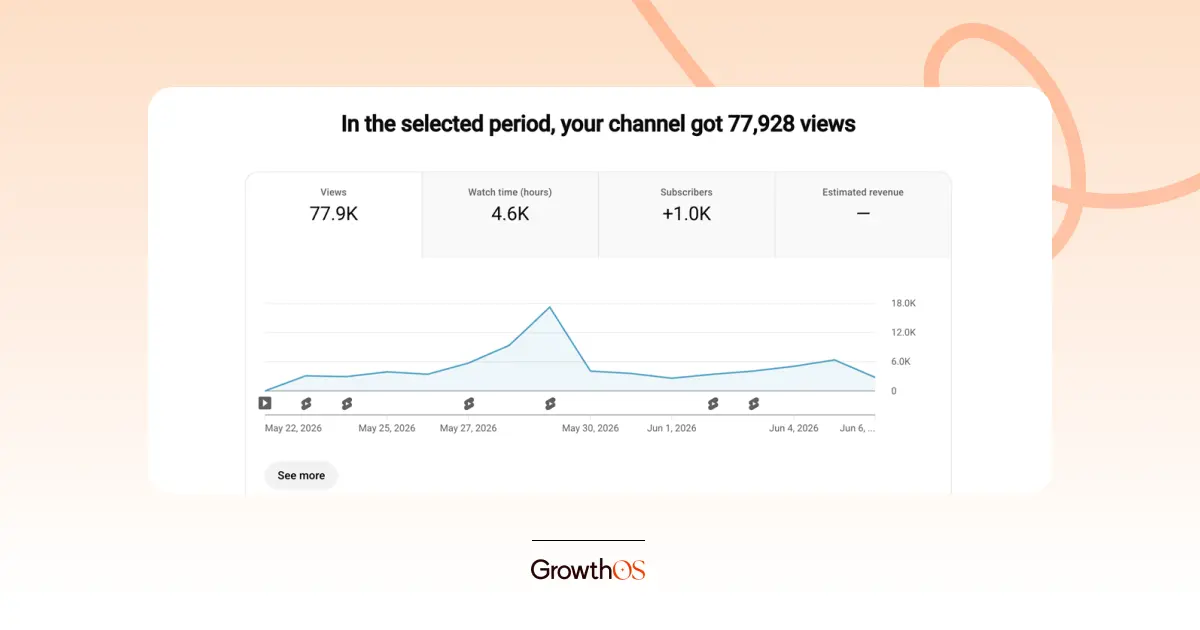
78K
Views
4.6K
Hours of watch time
3K+
Subscribers
Get Growth Insights Delivered to Your Inbox
Oops! Something went wrong while submitting the form.
Mr. Suketu Shah was launching a long-form interview podcast — 'Uncovered with Suketu Shah' - with no channel, no audience, and no prior content presence. We didn't inherit an existing YouTube channel to optimise; we built the entire thing from scratch.
That meant owning the strategy end to end: defining the channel's positioning, building the visual guidelines, and setting up the workflows and SOPs for production, editing, and channel management so the channel could run as a system rather than a series of one-off uploads.
The channel crossed its first 1,000 subscribers in under 14 days — driven almost entirely by long-form episode viewership rather than Shorts.
The Challenge
1. A Crowded Business Podcasting Space
Business podcasts are one of the most saturated formats on Indian YouTube. Founder interviews, startup breakdowns, and "how I built this" formats were already being published at scale by channels with far bigger distribution. A new channel entering with the same promise had almost no reason to be clicked.
2. Zero Existing Distribution, Viewership, or Community
There was no back catalogue, no email list, no social following to seed the first episodes with, and no community that could be relied on for early watch time. Every view had to be earned from cold audiences through packaging and retention alone.
3. A First-Time Host
Suketu had deep substance and experience as an operator, but he was new to being on camera. Retention on long-form conversations usually takes months of reps to get right — we didn't have months.
The Solution
We built the channel around a positioning bet, then engineered the production and packaging system to support it.
1. Re-positioning Away from "Business Podcast"
Instead of competing head-on in the business podcasting category, we positioned the show as a philosophical, first-principles conversation — where business surfaced as a consequence of the thinking, not as the headline.
This gave the channel a differentiated narrative in a category where nearly every competitor was selling the same promise, and gave the host room to ask the deeper questions he was actually good at.
2. Building the Channel Foundation from Scratch
Defined the content strategy, episode structure, and publishing plan before the first shoot.
Created visual guidelines for thumbnails, set design, and on-screen treatment to establish a consistent channel identity.
Documented workflows and SOPs across production, editing, and channel management so quality didn't depend on any single person in the chain.
3. Packaging as a Learning System
Launched each episode with multiple title and thumbnail variations built around differentiated narratives — not cosmetic A/B tweaks, but genuinely different angles on the same conversation.
Used the click behaviour on those variations to learn what the audience actually cared about, then fed those insights back into topic selection and guest framing for subsequent episodes.
4. Editing for Retention, Not for Length
Re-sequenced the conversation flow in the edit so the strongest moments landed early instead of being buried 40 minutes in.
Trimmed episodes aggressively so the runtime felt earned — the goal was for a viewer to finish an episode feeling it was worth their time, which is what drives the return visit.
5. Owning the Full Distribution Surface
Beyond YouTube, we took over the client's Instagram and LinkedIn, so the show's narrative, visual identity, and clip distribution stayed consistent across every platform the audience could encounter it on.
Results We Achieved
✅ 1,000 Subscribers in Under 14 Days
From a standing start with no audience, no distribution, and no community to seed from.
✅ ~78K Views and 4.6K Hours of Watch Time
Viewership was acquired primarily on the full episodes rather than on Shorts — which is the harder path, but the one that compounds.
✅ A Healthy Subscriber-to-View Ratio
Because the views came from long-form episodes, they converted into repeat viewers instead of one-time impressions. The audience that found the channel came back to it.
✅ Strong Retention Despite a First-Time Host
Average View Duration (AVD) and Average Percentage Viewed (APV) held up well above what's typical for a new long-form channel — a direct result of the re-sequencing and trimming discipline in the edit, and of a host with enough substance to ask questions that got guests into genuinely vulnerable territory.
Our Learnings
Want Similar Results for Your Channel?
Launching from zero in a saturated category is a positioning problem before it's a production problem. Our YouTube growth strategies can help you find the angle, build the system behind it, and turn cold viewers into a returning audience.



.svg)